


How to properly dispose of contacts
Contact lenses feel like they're barely there — that's why people love 'em — but these little plastic discs can mess with Mother Nature's delicate ecosystem. Fortunately, you can recycle contact lenses through manufacturer-sponsored programs. Knowing how to properly dispose of contacts helps keep them out of waterways and landfills and eases the burden on the environment.
Made of plastic and other non-biodegradable materials, contacts and their packaging hang around forever. Manufacturers are trying to reduce the environmental impact of wearing contact lenses by streamlining packaging, implementing greener production processes, and sponsoring recycling programs.
Here's how to properly dispose of contacts so you can give the planet some love.
-
Recycle contacts and their packaging through manufacturer-backed recycling programs.
-
Avoid flushing or rinsing contacts down the drain.
-
Throw contacts in the trash if you can't recycle them.
Learn the fine art of properly discarding and recycling used contacts. This guide also explains where to donate unused contact lenses and what to do with old or expired ones. With a little bit of care, you can enjoy 20/20 vision and take care of the environment, too.
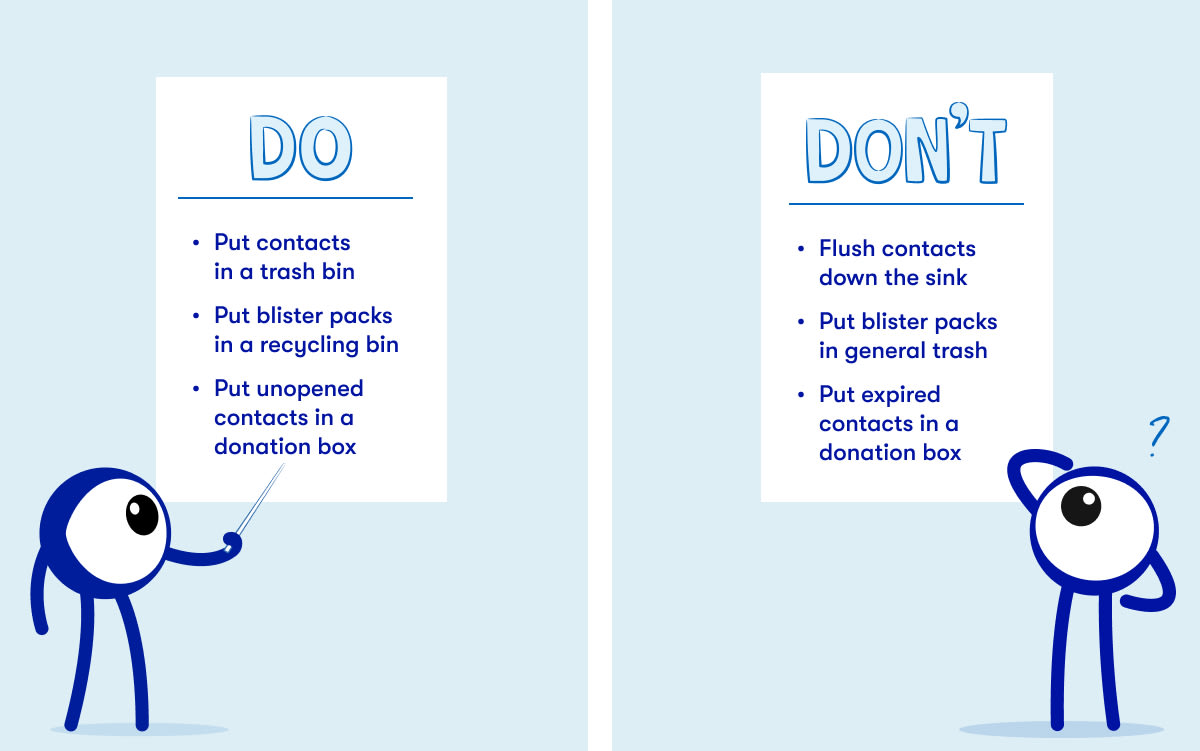
Is it okay to put contacts down the drain?
Nope. Contact lenses are harmful to the environment and shouldn't be put down a drain. Contacts that swirl down a sink or toilet seem to vanish but reappear in your municipal water system. They often linger at water treatment plants, like stubborn kids at a candy store. (Because Milk Duds, am I right?). The trapped plastic breaks further into microplastics that contaminate ground soil, lakes, and oceans. These tiny particles are harmful to wildlife and can enter the food chain.
The greener option? Keep your contacts out of the drain. Recycle them through specialized recycling programs or place them in the trash.
How to recycle contact lenses
Recycling contacts gets complicated because the lenses and their packaging are made of materials that must be handled separately. You have to play traffic cop, directing paper, foil, and plastic to the appropriate recycling programs. However, the planet will thank you for knowing how to properly dispose of contacts.
-
Contact lenses are recyclable through Bausch & Lomb's One by One recycling program. Check their website to find a drop-off point in your community. Many eye care professionals have collection boxes in their waiting rooms, calling out your name.
-
Opened contact lens blister packs can also be recycled through One by One. Save up your contact lenses, plastic containers, and foil tops, and march in proudly to a drop-off point with your planet-saving contribution. Yes, that green carpet they've rolled out is just for you.
-
The cartons that hold your blister packs (and the boxes they're shipped in when you buy contacts online) can usually be recycled with paper. Check what can go into your curbside box, as programs vary by region. If boxes get the thumbs-up, flatten them and place them in your recycling bin.
Can you recycle contact lens cases?
You can recycle contact lens cases but usually only through programs sponsored by contact lens companies. Lens cases don't mix well with the plastics in standard curbside recycling programs. It's hard to know what kind of material was used to make the cases, as there's no industry standard. Lens cases are also too small to easily separate from plastic bottles and jugs.
A good bet is to ask around and see if local eye care professionals participate in recycling programs. If you can't find a place to drop off cases, collect them yourself along with the caps from lens solution bottles. You don't have to display your collection like your Little League trophies, but you can be a recycling MVP. Once you've stockpiled enough, keep the plastics out of the landfill by shipping them to the Biotrue Eye Care Recycling Program, which is a partnership with TerraCycle.
How to recycle contact lens products
One of the big differences between conventional vs. disposable lenses is that reusable lenses require a whole entourage. You need contact lens solutions for rinsing or disinfecting, lens cases for storage, and rewetting drops to moisten your eyes. All these extras mean — you got it — more plastic.
To recycle complementary contact lens products:
-
Check the bottom of the contact lens solution bottle for a number inside a triangle. This tells you what kind of plastic it's made from. If it's accepted by your curbside recycling program, you're good to go. Slam dunk that bottle into the bin.
-
Check the bottom of your plastic contact lens case for the triangle mark. It likely doesn't have one, but if the stars have aligned and your curbside program accepts it, into the bin it goes.
-
Ask your eye care professional if they accept the contact lens products you can't put in a standard recycling bin. Some serve as a collection hub for manufacturer-backed recycling programs.
-
If you can't drop off contact lens cases and solution bottle caps locally, set them aside to send in yourself to the Biotrue Eye Care Recycling Program or similar initiative.
What to do with unused contact lenses
Occasionally, you end up with a stash of unused contact lenses languishing in the abyss of your bathroom drawer. Perhaps your prescription changed, or you didn't wear your disposable contacts as often as you thought you would. Maybe you swapped contacts for eyeglasses or LASIK surgery. Whatever the reason, it's time to Marie Kondo that clutter.
Your game plan depends on whether the unused lenses are expired.
-
Check the expiry date on the blister pack or box.
-
Expired contact lenses can be recycled through a manufacturer recycling program.
-
If you don't have access to a recycling program, dispose of expired lenses in the trash. Avoid flushing contacts down the drain.
-
Unexpired and unopened contact lenses can be donated to a nonprofit organization.
How to donate contact lenses
You can give unexpired contact lenses a new chance at life and help someone else see more clearly.
To donate contact lenses:
-
Confirm the blister pack is sealed and in its original packaging.
-
Ask your eye care professional if you can return or exchange unopened contact lenses.
-
Find a donation program. For example, DonateContacts collects and ships contact lenses to Feed the Children to give free contacts to kids in need. They also take unused contact lens solutions and cases.
-
Ship the lenses according to the instructions.
What to do with old or expired contact lenses
Contacts past their expiry date shouldn't be used or donated — be sure to recycle or properly discard them. They can become a health hazard, like the leftovers-turned-science experiment at the back of some fridges. (Public service announcement: Go check your fridge now!).
Over time, contact lenses, solutions, and packaging can degrade, causing discomfort and risks to your eye health. Here's what to do with old or expired contact lenses:
-
Open each blister pack and separate the materials plastic, foil, and contact lenses.
-
Find a local eye care center that serves as a drop-off point for Bausch & Lomb's One by One recycling program.
-
Drop off the plastic container, foil seals, and contact lenses. The program accepts empty and dry containers.
-
If you can't recycle the contact lenses, throw the unopened blister pack in your trash. Avoid washing contact lenses down the drain.
A green routine: How best to dispose of contact lenses
It can be confusing to know how to properly dispose of contact lenses — blister packs go here; expired contacts go there — but it doesn't take long to master each step:
-
Recycle used contact lenses, blister packs, and contact lens cases through manufacturer-sponsored recycling programs.
-
Donate unused and unexpired contacts to nonprofit organizations that ensure perfectly good contacts are put to use.
-
Toss anything you aren't able to recycle or donate, including expired contact lenses, in the trash.
-
Never, ever, ever (just want to be clear here!) wash contacts down the drain.
It's possible to take care of your vision and the planet by disposing of contact lenses responsibly. Whether you opt for daily disposable or extended-wear contact lenses, shop 1-800 Contacts for the brand your eye care professional recommends.
Did you know you can order contacts online?
Say goodbye to trips to the eye doctor and hello to convenience! With 1-800 Contacts, you can easily order your contact lenses online and have them delivered straight to your door. Plus, our online vision exam makes it simple to get the prescription you need without leaving home. And the best part? You’ll save money on your first order with 1-800 Contacts. It’s never been easier to get your contacts!
Original publish date: 9/12/2023
Updated date: 11/17/2025