


Contact Lens vs. Glasses Prescription: What's the Difference?
No, a contact lens prescription and a glasses prescription are not the same thing. They're related, but definitely not interchangeable. Using one in place of the other is a common mistake that can lead to the wrong lenses, poor fit, or blurry vision.
Here's what makes them different and what you actually need to order the right contacts.
Why contact and glasses prescriptions aren't the same
Glasses sit a few millimeters in front of your eye. Contact lenses sit directly on your eye. That distance changes how the lens needs to work, especially at stronger prescriptions.
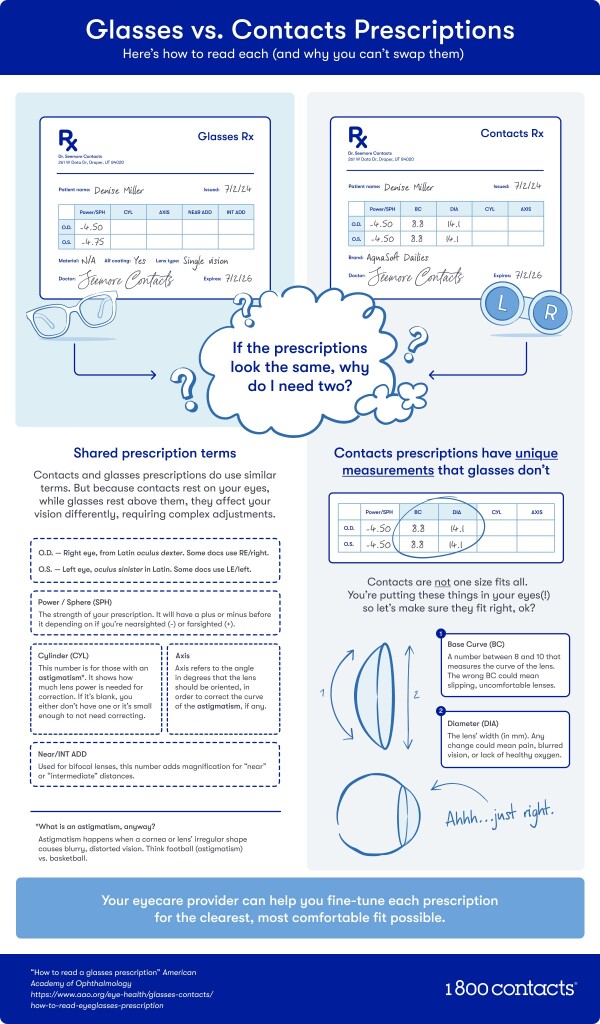
The technical term for this is vertex distance. At higher prescription strengths, even a small difference in vertex distance can dramatically affect how well it corrects your vision. So the power value on a glasses prescription almost certainly needs to be adjusted for a contact lens prescription to achieve the same result.
On top of that, contact lens prescriptions contain fit measurements that glasses simply don't have. A glasses prescription tells you the lens power. A contact lens prescription also tells you the lens power, plus how to fit that lens on your specific eye surface.
What each prescription includes
|
Field |
Glasses Prescription |
Contact Lens Prescription |
|
SPH (sphere / power) |
Yes |
Yes |
|
CYL (cylinder) |
Yes, if astigmatism |
Yes, if astigmatism |
|
Axis |
Yes, if astigmatism |
Yes, if astigmatism |
|
ADD |
Sometimes |
Sometimes (multifocal) |
|
Base curve (BC) |
No |
Yes |
|
Diameter (DIA) |
No |
Yes |
|
Brand / lens type |
No |
Often yes |
The fields at the bottom of that table are the ones that make a contact lens prescription contact-lens-specific. They're not about vision strength. They're about fit.
What base curve and diameter mean
- Base curve is the curvature of the back of the lens, the side that sits on your cornea. A lens with the wrong base curve can move around too much, sit too tightly, or feel uncomfortable.
- Diameter is the width of the lens from edge to edge. Most soft lenses fall between 13.8 and 14.5mm, and getting this right keeps the lens centered on your eye.
Neither of these can be derived from a glasses prescription. They require actual measurements of your eye, which is why a separate contact lens fitting exists.
Why contact lenses need their own exam and fitting
Eye health matters alongside lens power
Because contact lenses sit directly on the eye, the fitting process isn't just about getting the power right. It also checks:
- The shape and curvature of your cornea
- Tear film quality and whether dry eye could affect lens comfort
- Whether any existing eye conditions make certain lens types a better or worse fit
- How a trial lens moves and centers on your eye during wear
A lens could correct your vision perfectly, but still cause problems if it doesn't fit well, or if your eye isn't well-suited to a particular lens type.
A contact lens exam is separate from a comprehensive eye exam
A comprehensive eye exam checks your overall vision and eye health. A contact lens exam adds the measurements and trial fitting specific to contact lenses. This is why you may see them listed as separate appointments or separate fees. It's not a billing trick. They're actually different evaluations.
A typical contact lens exam includes:
- Corneal topography or keratometry to measure the shape of your cornea
- Base curve and diameter determination for your eye
- A trial lens fitting to check how the lens sits, centers, and moves
- Vision check with the trial lens in place
- Follow-up adjustments if needed before the prescription is finalized
Can you convert a glasses prescription to a contact lens prescription?
Sometimes a rough power conversion can be estimated, particularly at higher prescriptions where vertex distance has a greater effect. But even if the power adjustment is accurate, it still doesn't give you a usable contact lens prescription.
A conversion doesn't tell you:
- Your base curve
- Your diameter
- Which lens brand or material works for your eye shape
- Whether your tear film or corneal health affects lens comfort
Online conversion charts have the same limitation. They can estimate power adjustments, but they can't replace the fit information that only comes from an actual contact lens exam.
What happens if you try to use a glasses prescription for contacts
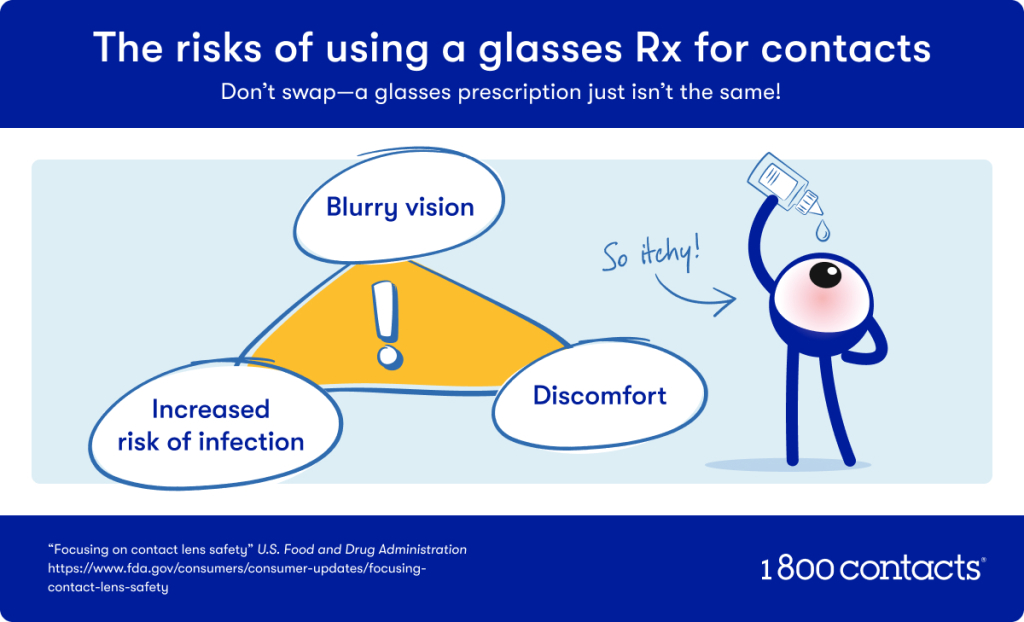
- Blurry vision, if the power isn't adjusted for the difference in lens position
- Poor fit, if base curve and diameter aren't accounted for
- Discomfort, from a lens that doesn't sit correctly on the cornea
- Irritation or corneal issues, especially with extended wear
"Close enough" isn't really close enough when it comes to something sitting directly on your eye!
Quick guide to common prescription terms
- SPH: Your basic vision correction strength, in diopters. Minus = nearsightedness, plus = farsightedness.
- CYL: Astigmatism correction amount. Only present if you have astigmatism.
- Axis: The orientation of astigmatism correction in degrees. Always paired with CYL.
- ADD: Extra power for near vision in multifocal lenses. Appears on prescriptions for presbyopia.
- BC (base curve): Curvature of the back of the contact lens. Contact lens prescriptions only.
- DIA (diameter): Width of the lens. Contact lens prescriptions only.
- Brand: Contact lens prescriptions are often specific to a lens brand because fit varies between products.
Having different values for your right eye (OD) and left eye (OS) is completely normal. Most people's eyes aren't identical.
When you need a separate contact lens exam
You'll need a contact lens exam if:
- You want to wear contacts for the first time
- You're switching to a new brand or lens type
- You need toric lenses for astigmatism
- You're exploring multifocal options
- You're having comfort issues like dry eye with your current lenses
Prescription validity can also differ between glasses and contact lens prescriptions depending on your provider and location. Check the expiration date on each separately.
Frequently asked questions
Can I use my glasses prescription to order contacts?
No. Retailers require a valid contact lens prescription to ship lenses. A glasses prescription doesn't include the fit details needed for contact lenses and can't be substituted.
Do I need a separate eye exam for contacts?
Yes. You need a contact lens exam in addition to a comprehensive eye exam. The contact lens exam includes corneal measurements and a trial fitting that a standard eye exam doesn't cover.
Can a glasses prescription be converted to a contact lens prescription?
No. Power adjustments can sometimes be estimated, but that still doesn't give you a complete contact lens prescription. Base curve, diameter, and brand fit can only come from a contact lens fitting.
Did you know you can order contacts online?
Need to renew your contact lens prescription? Skip the extra trips and guessing on your contact lens prescription. Our online vision exam makes it easy to do from home. And new customers save on their first order, too. With 1-800 Contacts, you can order your lenses in just a few clicks and have them delivered right to your door.
Original published: 3/11/2020
Updated: 10/28/2026