


How to help your child transition from glasses to contacts
Wondering how to help your child transition from glasses to contacts? It's just a matter of making sure they're ready, preparing them for the basics, and taking it one step at a time. The switch may feel like a big step for both of you, but with the right preparation, most kids adjust quickly and comfortably.
In this guide, we'll walk you through how to tell if your child is ready, what to expect with the transition, and tips for making things go smoothly. You'll also learn how to handle those "Hey, there's something in my eye!" moments without panic.
Is your child ready for contacts?
If your child is asking about contact lenses, the first step is to have a conversation with their eye doctor. A fitting appointment can help determine if contacts are the right fit for your child's eyes, vision needs, and lifestyle.
Contacts are usually appropriate starting between the ages of 8 and 12. But remember: Age ain't nothing but a number (shout-out to Aaliyah). Maturity is what matters. Ask yourself these questions:
-
Does my child do their chores without constant reminders?
-
Has my child ever broken their glasses?
-
Does my child routinely misplace their glasses for hours on end?
Contact lenses come with rules about cleaning, storage, and replacement schedules. Setting clear expectations early can help you prevent frustration later.
What to know if your child wants contact lenses
Readiness is less about age and more about whether your child can follow a consistent care routine independently. Still not sure if they're ready? Here are a few questions to guide the conversation:
-
Can your child wash their hands regularly (especially after eating and using the bathroom) without 100 reminders?
-
Can they handle the (temporary) weirdness of putting something in each eye?
-
Do they really want to wear contact lenses, or are their peers pressuring them to make the switch?
If you answer "yes" to these questions, great. You can learn how to help your child transition from glasses to contacts. Otherwise, there's no rush.
Ultimately, an eye doctor is the one who makes the final call on readiness. They'll assess fit, make sure your child's eyes are healthy, and determine whether your child is mature enough to care for contacts properly. If you want to set realistic expectations, here's a guide that explains what it's like to wear contact lenses for the first time.
Tips on how to help your child transition from glasses to contacts
Once you get the all-clear from your child's eye doctor, follow these tips to ease the transition.
Start with the basics
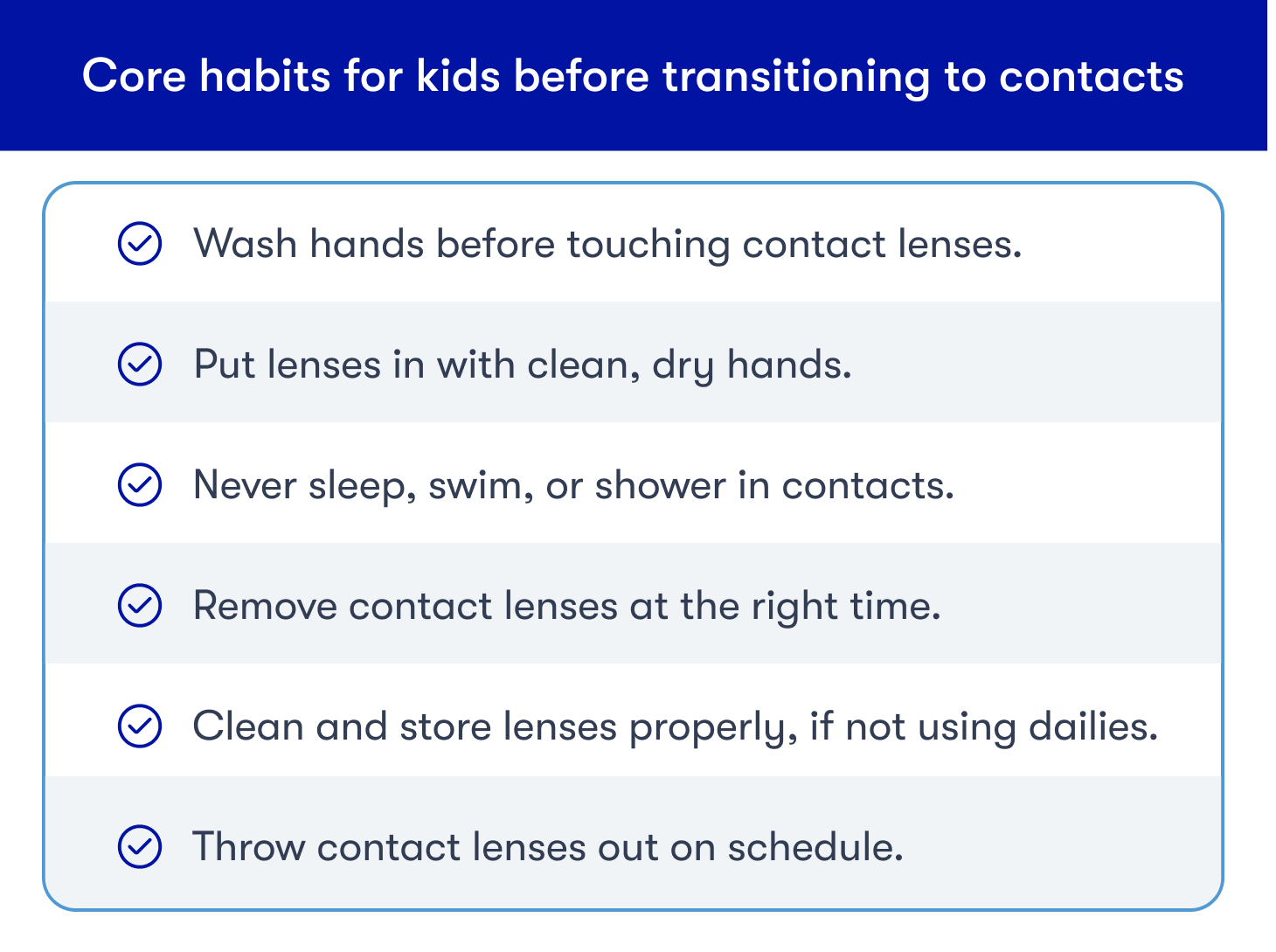
No matter how obvious this information is to you, it may be the first time your child hears it. Contact care fundamentals are easy to overlook, but they can have a big impact on eye health and lens comfort. Start with these basics:
-
Cleanliness. Wash hands thoroughly before handling contacts. No ifs, ands, or buts.
-
Eye safety. Remove contacts before sleeping, swimming, or showering. Eye contacts and tap water aren't BFFs.
-
Fresh contacts. Follow the manufacturer's replacement schedule exactly.
-
Contact storage. Store contacts in fresh lens solution after every wear. Reusing lens solution is a great way to end up with bacteria in your eye.
Your child's eye doctor will cover this information at the fitting appointment, but it doesn't hurt to reinforce it at home.
Take it slow
Have your child start by wearing their new contacts for a few hours per day. This reduces irritation and gives new users time to adjust. Also, keep their glasses nearby. For the first few weeks of wear, contacts are an option, not the only option.
Supervise early on
In the beginning, stay in the room while your child puts in and removes their lenses. There's no need to turn into a helicopter parent — just make sure they're building good habits. Here's a refresher on how to insert contacts like a pro.
Consider daily disposable lenses
Kids and daily disposables often go together like peanut butter and jelly. Why? Because daily disposables require no cleaning, no storage, and no wondering about whether the lenses need to be replaced.
With daily disposable lenses, your child can open a fresh pair every day and throw them away at night. This reduces the risk of infection and eliminates several steps from the daily care routine.
Keep up with eye doctor visits
A child's vision often changes over time, making annual eye exams important. The good news is that unopened contacts can be exchanged, so there's no need to panic if your child's prescription changes suddenly.
Be patient
Putting in and removing contacts takes a little patience. Blinking and mild frustration are normal. The key is consistency. If you're patient and supportive, there's a good chance your child will get the hang of it quickly. Share this guide to adjusting to contacts if they need a little extra support.
How to address a child's comfort issues with contacts
Some discomfort is normal when a child first starts wearing contacts. Most issues resolve on their own within the first week as their eyes adjust to the lenses. These are some of the most common comfort-related complaints:
-
There's something in my eye! This is extremely common during the first few days of wear.
-
Mild dryness or irritation. These symptoms often appear as a new user increases their wear time.
-
Difficulty inserting or removing lenses. Practice makes perfect, so these issues usually resolve quickly.
-
My lenses feel "off." Sometimes this happens if a new user inserts their contact lens inside out. Tiny pieces of debris can also get stuck under a contact.
Rewetting drops can help make contacts more comfortable. Check labels carefully to make sure you're getting rewetting drops and not general eye drops (or contact lens solution!).
If something feels off, have your child remove the lens, clean it (if it's not a daily disposable), and try again. A quick reset may be enough to stave off discomfort.
That said, if discomfort lasts for more than a week or is accompanied by redness, pain, or blurry vision, contact your child's eye doctor.
Setting your child up for contact lens success
With the right preparation, a little guidance from an eye care professional, and a lot of patience, many children can transition from glasses to contacts. Good habits start early, so make sure your child is ready, take it slow, and remember that comfort issues are usually temporary.
The good news is that you don't have to navigate this milestone alone. Your child's eye doctor can provide personalized advice and support. When you're ready, 1-800 Contacts can help you find the right brand based on your child's lens prescription.
Did you know you can order contacts online?
Say goodbye to trips to the eye doctor and hello to convenience! With 1-800 Contacts, you can easily order your contact lenses online and have them delivered straight to your door. Plus, our online vision exam makes it simple to get the prescription you need without leaving home. And the best part? You’ll save money on your first order with 1-800 Contacts. It’s never been easier to get your contacts!
Original publish date: 11/16/2021
Updated date: 4/24/2026