How to measure pupillary distance at home
If you’re ordering glasses online, you may need your pupillary distance (PD). PD measures the distance between the centers of your pupils in millimeters.
This measurement helps your lenses line up correctly with your eyes so you can see clearly and comfortably.
In this guide, you’ll learn:
-
What pupillary distance is
-
Why PD matters for glasses
-
How to measure PD at home
-
Common PD mistakes to avoid
-
When to get a professional measurement
What is pupillary distance?
Pupillary distance, or PD, is the distance between your pupils measured in millimeters.
Your PD helps place the optical center of your lenses directly in front of your eyes. This is where your prescription works best.
A correct PD can help with:
-
Clear vision
-
Better comfort
-
Reduced eye strain
-
Better lens performance
If your PD is incorrect, your glasses may feel uncomfortable or cause blurry vision, headaches, or eye strain.
Why is PD important for glasses?
When glasses are made, the lenses are centered based on your PD measurement.
This becomes even more important for:
-
Strong prescriptions
-
Progressive lenses
-
Multifocal lenses
-
All-day glasses wear
Even a small PD error can affect comfort and vision quality.
Why isn’t PD listed on my prescription?
PD is not always included on an eyeglass prescription.
That’s because many eye doctors consider it a fitting measurement rather than part of the eye exam itself.
If your prescription does not include PD, you can:
-
Ask your eye doctor for it
-
Measure it at home
-
Use an online PD tool or app
Types of pupillary distance measurements
There are two main types of PD measurements.
Binocular PD
Binocular PD measures the total distance between both pupils.
This is the most common PD measurement for ordering glasses online.
Monocular PD
Monocular PD measures from the center of your nose to each pupil separately.
This measurement is often used for:
-
Progressive lenses
-
Higher prescriptions
-
More precise lens placement
How to measure pupillary distance at home
You can measure your PD at home with:
-
A millimeter ruler
-
A mirror or another person
-
An online PD tool or app
How to measure PD with a phone or app
Some people use smartphone apps or online PD tools instead of a ruler.
Most apps work by:
-
Using your phone camera
-
Scanning your face
-
Using a card for measurement scale
-
Calculating the distance between your pupils
To improve accuracy:
-
Follow the instructions carefully
-
Use good lighting
-
Keep your head level
-
Repeat the measurement multiple times
If possible, compare the app result with a manual measurement.
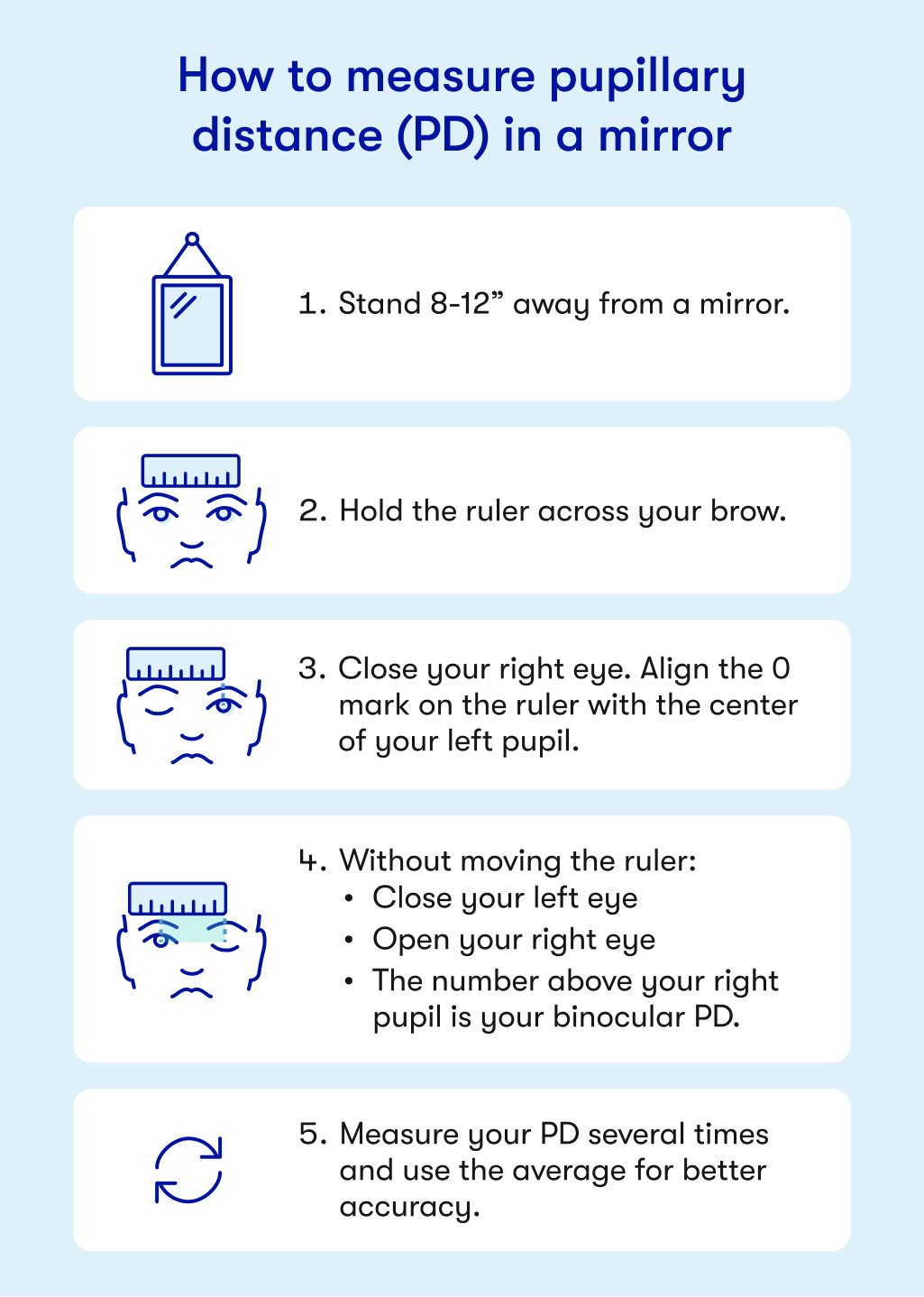
How to measure PD with a mirror
Step 1: Stand in front of a mirror
Stand about 8 to 12 inches away from the mirror.
Step 2: Position the ruler
Hold the ruler across your brow just above your eyes.
Step 3: Line up your left pupil
Close your right eye.
Align the zero mark on the ruler with the center of your left pupil.
Step 4: Measure your right pupil
Without moving the ruler:
-
Close your left eye
-
Open your right eye
-
Read the number lined up with the center of your right pupil
That number is your binocular PD.
Step 5: Repeat the measurement
Measure your PD several times and use the average for better accuracy.
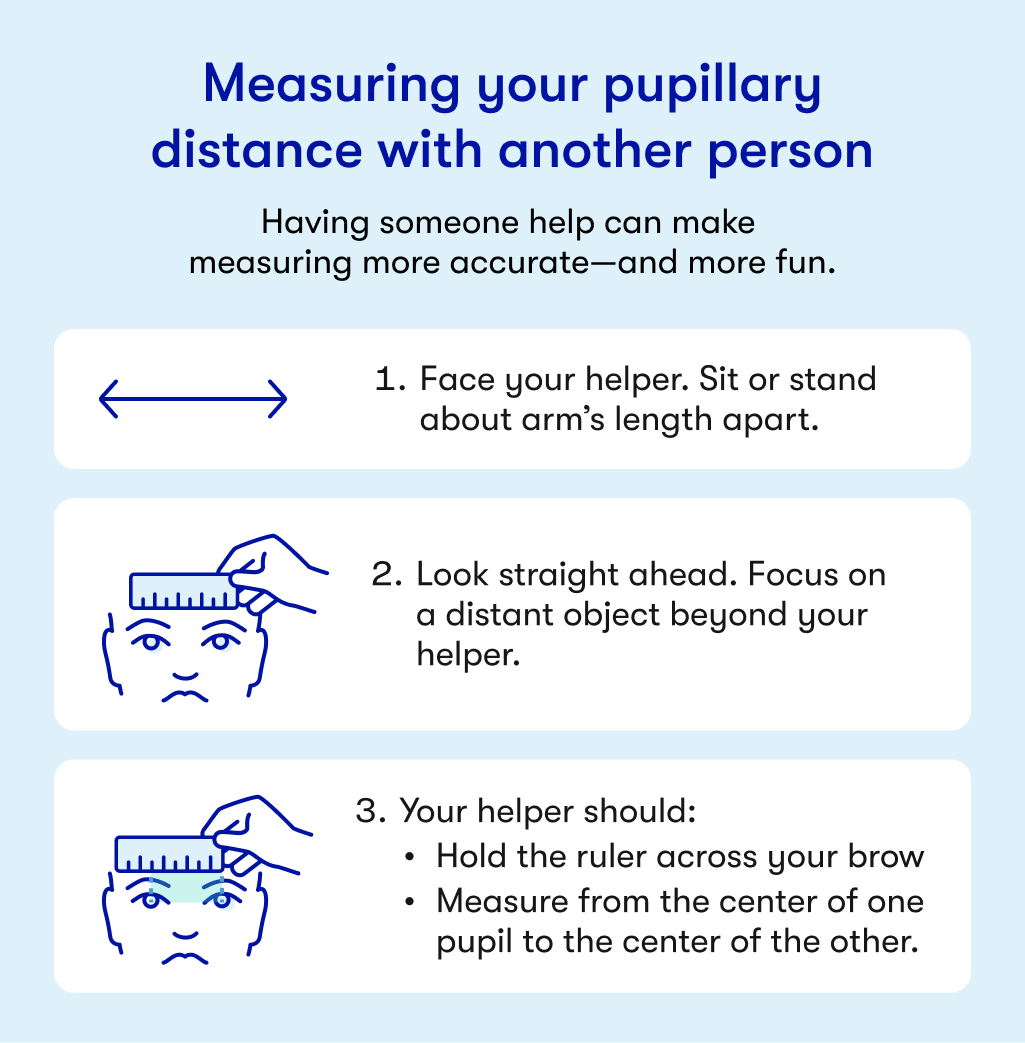
How to measure PD with another person
Having someone’s help can make the measurement more accurate.
Step 1: Face your helper
Sit or stand about arm’s length apart.
Step 2: Look straight ahead
Focus on a distant object behind your helper.
Step 3: Measure pupil to pupil
Your helper should:
-
Hold the ruler across your brow
-
Measure from the center of one pupil to the center of the other pupil
Step 4: Double-check the measurement
Repeat the process a few times to confirm the results.
How to measure monocular PD
To measure monocular PD:
-
Place the ruler at the center of your nose
-
Measure to the center of your left pupil
-
Repeat for your right pupil
You’ll end up with two measurements, one for each eye.
Tips for getting an accurate PD measurement
For the best results:
-
Measure more than once
-
Use a ruler with millimeter markings
-
Keep your head straight
-
Look at a distant object
-
Keep the ruler level
If your measurements vary a lot, consider getting your PD measured professionally.
Common PD measuring mistakes
Small mistakes can affect how your glasses feel.
Common errors include:
-
Measuring in inches instead of millimeters
-
Tilting the ruler
-
Looking at the ruler instead of straight ahead
-
Moving your eyes during measurement
-
Only measuring once
When should you get PD measured professionally?
At-home PD measurements work well for many people, but professional measurements may be better if:
-
You have a strong prescription
-
You need progressive lenses
-
Your glasses have felt uncomfortable in the past
-
Your measurements seem inconsistent
Optical professionals use specialized tools for more precise measurements.
Is it okay to measure PD at home?
Yes. Measuring PD at home is common when ordering glasses online.
The biggest concern is accuracy, not safety.
If your glasses feel uncomfortable after ordering, an incorrect PD could be the reason.
Key takeaways about pupillary distance
-
PD measures the distance between your pupils
-
PD helps align your lenses correctly
-
You can measure PD at home with a ruler
-
Accurate measurements improve comfort and vision
-
Professional measurements may help with stronger prescriptions or progressive lenses
Order glasses online with ease
You can order glasses online without visiting a store. The Framery allows you to browse frames, customize lenses, and upload your prescription from home.
With simple ordering, clear pricing, and delivery to your door, buying glasses online can be fast and convenient.