


How to put in and take out contacts with long nails
Ever looked at your freshly done nails and thought, "How am I supposed to put my contacts in now?" You're not alone.
Long nails can be one of the most common challenges for contact lens wearers, especially if you're new to contacts. The good news is that long fingernails don't mean you have to give up contact lenses. The key is learning to use the pads of your fingers rather than your nails, and slightly adjusting your hand position.
Once you’ve got it down, putting in and taking out contacts with long nails can become just as easy as it is for someone with short nails.
Start with a setup that makes contact handling easier
Before you touch your lenses, take a minute to set yourself up for success.
Quick contact lens checklist
Before inserting or removing contacts:
- Wash your hands thoroughly with soap and water
- Dry your hands with a clean, lint-free towel
- Make sure no lotion or oily residue remains on your fingers
- Check the lens for tears, debris, or damaged edges
- Use a mirror with good lighting
- Work over a clean counter or sink
A steady setup reduces stress and makes it easier to focus on your technique.
Why long nails make contacts feel harder
The challenge isn't that contacts and long nails don't work together.
The challenge is that long nails change the way your fingers approach the lens.
With short nails, it's easy to bring your fingertip directly toward your eye. With longer nails, the nail often reaches the eye before the finger pad does.
This can lead to:
- Poking your eye
- Difficulty pinching the lens
- Nervous blinking
The solution is simple: change your angle so your finger pads do the work while your nails stay pointed away from your eye.
Use the pads of your fingers, not your nails
This is the most important technique to learn.
Instead of approaching the lens straight-on with the tips of your fingers, slightly rotate your hand.
Your goal is to use the fleshy pad of your finger while keeping the nail angled away from the eye.
This adjustment feels awkward at first but quickly becomes second nature.
Different nail shapes may require different techniques
The longer or sharper the nail, the more important hand positioning becomes.
Round nails
Often the easiest shape for contact lens wear because the edges are less likely to scratch the skin around the eye.
Almond nails
Usually work well, but may require a slight side angle during removal.
Square nails
Can occasionally catch the eyelid or lens edge if approached straight-on.
Stiletto or very pointed nails
Typically require the most side-angle positioning and careful eyelid control.
The sharper or longer the nail, the more you should focus on using finger pads and maintaining a safe angle. 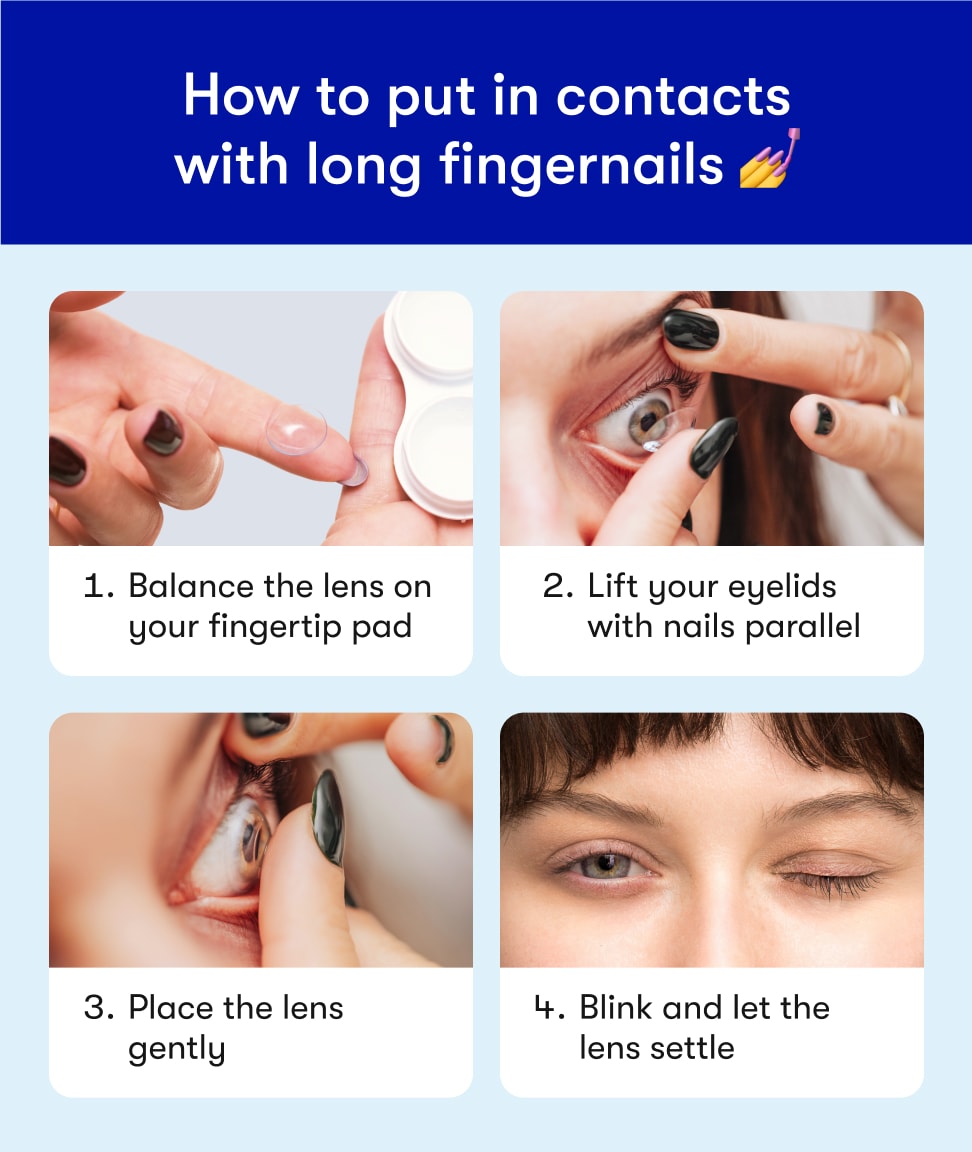
How to put in contacts with long nails
Step 1: Balance the lens on your fingertip pad
Place the contact lens on the pad of your index finger.
Check that:
- The lens looks like a bowl (not a plate)
- The edges are even
- The lens isn't inside out
If it looks more like a plate with flared edges, flip it over before continuing.
Step 2: Hold your eyelids open
Using your non-dominant hand:
- Lift your upper eyelid from near the lashes
Using the middle finger of your dominant hand:
- Gently pull the lower eyelid down
Keep your nails angled away from your eye.
Your skin should contact the eyelid, not the nail itself.
Step 3: Place the lens gently
Looking straight ahead or slightly upward:
- Slowly bring the lens toward your eye with your finger pad.
- Touch the lens gently to the eye.
- Pause briefly.
- Release the lens.
Don't rush.
Contacts naturally adhere to the tear film on your eye and don't require force.
Step 4: Blink and let the lens settle
Release your eyelids and blink slowly a few times.
If the lens:
- Lands off-center
- Folds on your finger
- Sticks during insertion
simply remove it, rewet if necessary, and try again.
This is normal, especially when you're learning. 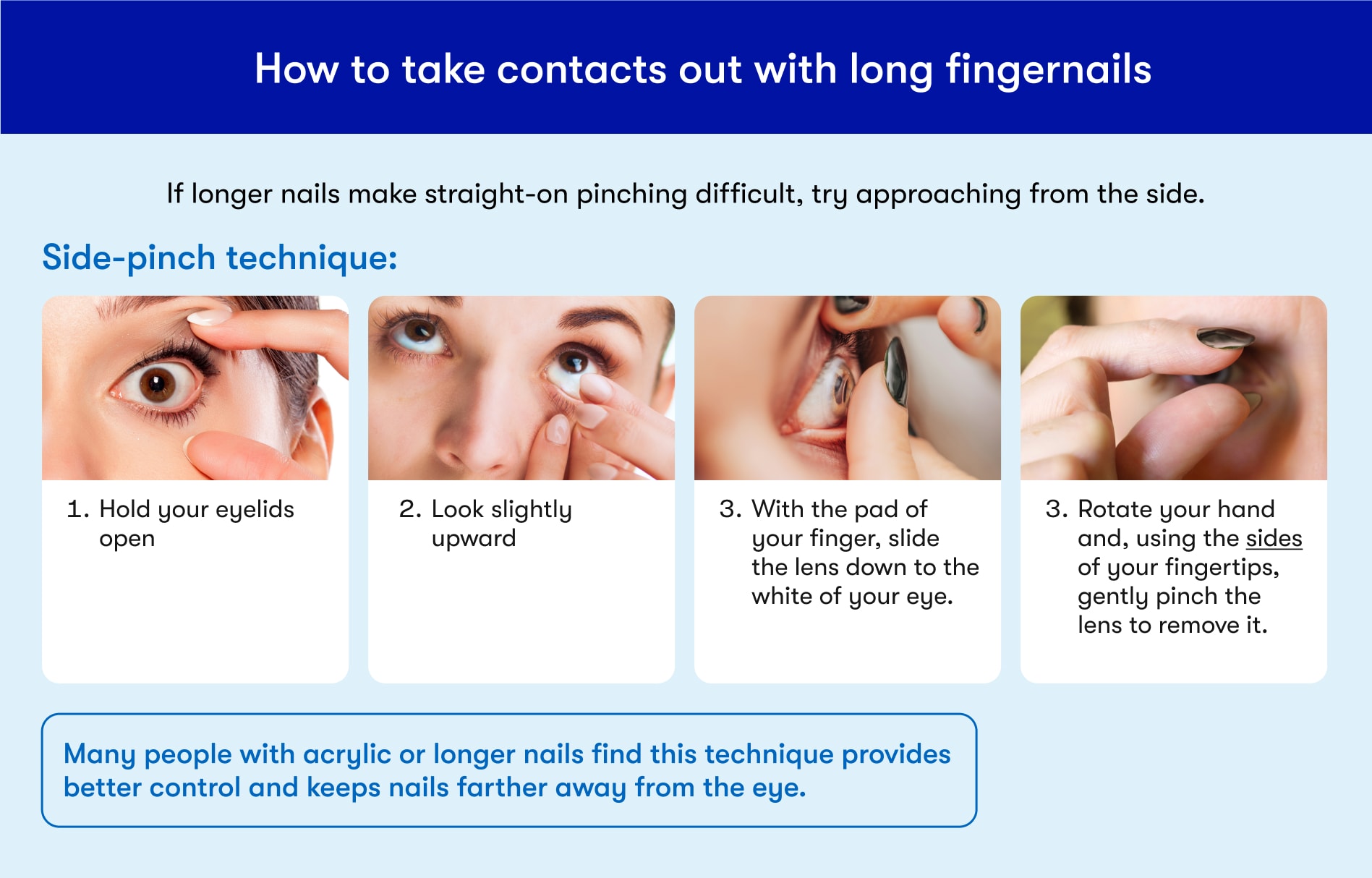
How to take out contacts with long nails
Removal is usually where long nails create the biggest challenge.
Fortunately, there are a couple of techniques that work very well.
Method 1: Slide and pinch with finger pads
This is the easiest method for most people.
Step 1
Hold your eyelids open.
Step 2
Look slightly upward.
Step 3
Use the pad of your index finger to gently slide the lens downward onto the white part of your eye.
Step 4
Use the pads of your thumb and index finger to gently pinch the lens.
The lens should fold slightly and lift away from the eye.
Can I pinch my contacts out?
Yes.
Pinching is the standard removal technique for soft contact lenses.
The important part is using your finger pads rather than your fingernails.
Method 2: Side-pinch technique
If long nails make straight-on pinching difficult, try approaching from the side.
Instead of bringing your fingers directly toward the lens:
- Rotate your hand slightly
- Approach from a side angle
- Use the sides of your finger pads
Many people with acrylic or longer nails find this technique provides better control and keeps nails farther away from the eye.
Why daily contacts can feel harder to remove
Daily disposable lenses are often even thinner than monthly or biweekly lenses.
Because they're so thin, they can:
- Fold more easily
- Stick closer to the eye
- Be harder to grip
If your daily lenses seem difficult to remove:
- Make sure your fingertips are dry
- Slide the lens before pinching
- Blink a few times first if your eyes feel dry
Usually, it's a technique issue rather than a problem with the lens itself.
What if I can't get my contact lens out?
First: don't panic.
Most "stuck" contacts are simply dry contacts.
Try:
- Blinking several times
- Using contact lens-safe rewetting drops
- Looking in different directions
- Waiting a minute or two
- Trying the slide-and-pinch method again
Will a stuck contact eventually come out?
Most soft contacts can be removed once they're properly lubricated and mobile again.
However, stop trying and contact an eye doctor if:
- The lens won't move
- Your eye becomes painful
- Your eye becomes very red
- Your vision becomes blurry
- You're unsure if the lens is still present
Common mistakes to avoid
Long nails don't usually cause contact lens problems. Certain habits do.
Stop:
- Using nail tips instead of finger pads
- Rushing
- Pulling directly on the lens before sliding it
- Repeatedly poking at the eye
- Handling lenses with wet or lotion-covered hands
Start:
- Using side-angle approaches
- Sliding lenses before pinching
- Keeping fingertips dry
- Practicing the same method every time
- Taking breaks when frustrated
Small adjustments that make a big difference
If long nails continue to make contacts difficult:
- File sharp edges smooth
- Improve your lighting setup
- Lean closer to the mirror
- Practice eyelid control without a lens first
- Consider a contact lens handling tool if recommended by your eye care professional
Many people find that one or two small changes in technique completely solve the problem.
Long nails and contacts can absolutely work together
Long nails don't automatically rule out contact lenses.
The secret isn't a special trick. It's learning how to use your finger pads, controlling your eyelids, and approaching the lens from angles that keep your nails away from your eye.
Once you find a method that works, stick with it. Insertion and removal become much easier when you repeat the same movements every day.
And remember: if a lens feels truly stuck, your eye becomes very irritated, or something doesn't feel right, stop and contact your eye doctor for guidance.
Did you know you can order contacts online?
With 1-800 Contacts, you can easily order your contact lenses online and have them delivered straight to your door. Plus, our online vision exam makes it simple to renew your prescription without a trip to the waiting room. It's never been easier to get your contacts.