


Monolid Eyes
Monolid eyes have a single expanse of skin stretching from the eyebrow to the lash line with no visible crease in the eyelid. This type of eyelid structure is common among people of East Asian descent, but it can occur in any population — including people with almond-shaped eyes. Genetic conditions, such as Down syndrome and Phenylketonuria, can also cause it.
Monolid eyes are a recessive trait, and some researchers think this eyelid shape might have evolved to help protect the eyes from harsh environments.
You might see the terms "monolid eyes" and "epicanthal folds" used interchangeably, but they refer to slightly different structures. Regardless of the name you use, these eyelids bring a unique beauty and diversity to the human population.
Epicanthic fold vs. monolid
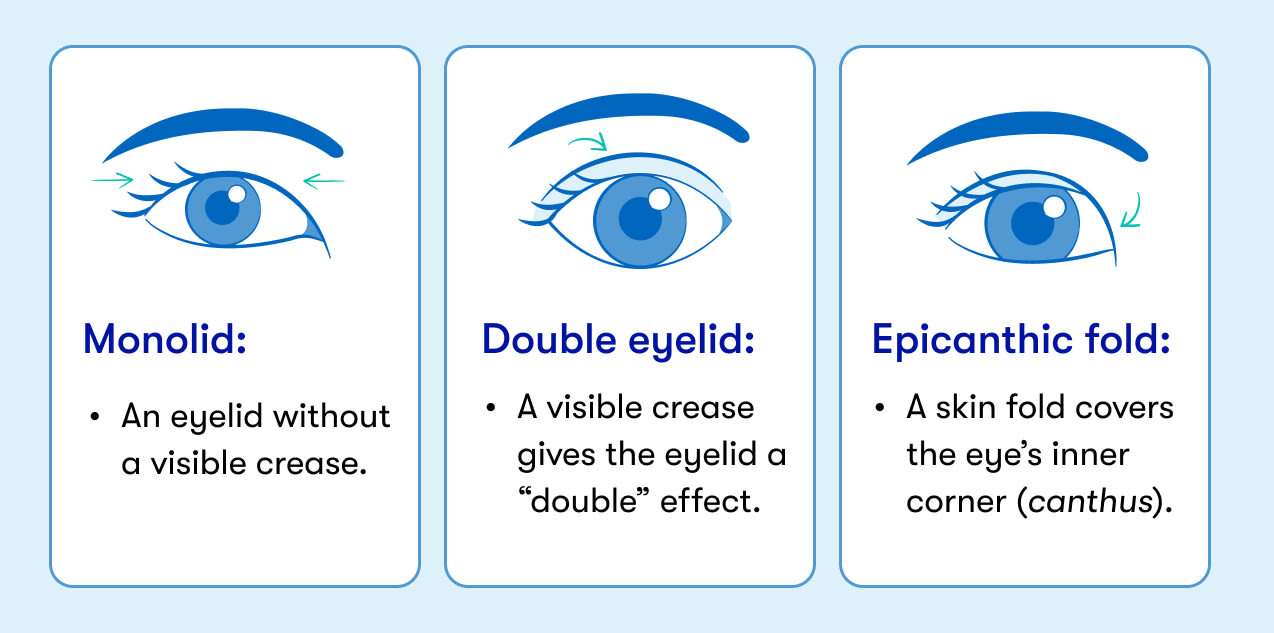
A monolid eye is an eyelid without a crease, while an epicanthic (or epicanthal) fold is a part of the eyelid that covers the inner corner of the eye. While some people with monolids have epicanthic folds, others don't.
-
Epicanthic fold: This small fold of skin extends across the inside corner of the eye. It helps shape the inner part of the eye, creating a distinctive look and a strong almond shape. You can also have an epicanthic fold if you have a monolid or a double eyelid.
-
Monolid: This crease-free eyelid is made from a single stretch of skin. It often gives the eye a smoother, flatter appearance.
Monolid vs. double eyelid
A monolid is an eyelid without a defined crease, while a double eyelid has a distinct fold of skin between the upper and lower parts. The type of eyelid you have isn't usually related to eye conditions; it's mostly a visual (pardon the pun) difference.
-
Double eyelid: A double eyelid folds in the middle, which pulls up the upper lash line and makes the eyes look bigger. This usually happens because the skin is attached closely to a muscle called the levator aponeurosis. When you open your eyes, these attachments pull on the skin and create a crease.
-
Monolid: Monolids often cover more of the eye than double eyelids, which can make the eye look smaller or narrower. They happen because the skin is attached differently (or not at all) to the underlying muscles.
Do monolid eyes affect your vision?
Monolids don't usually impact your vision. People who have monolids have similar fields of view as people with double eyelids.
In rare cases, your monolids could cause issues with dry eyes. That's because your eyes stay hydrated and cleansed with the tears that come out of the lacrimal gland, which is located in the outer top corner of your eye. If you have a pronounced monolid or a monolid that's starting to droop, it could block the tears from lubricating the surface of the eye — usually, while you're sleeping. However, this is pretty unlikely, so it's a good idea to investigate other causes of dry eye and use a moisturizing product, such as OPTI-FREE PureMoist Drops.
There's also a very loose potential connection between monolids and excessive tearing. If a monolid blocks drainage, you might find that your eyes are unusually wet.
For most people, monolids are merely an aesthetic difference. Your vision is influenced by many other factors, including genetics and individual health concerns.
Why do people have monolids?
Most people have monolids because of their genetics. If both your parents have monolids, you probably inherited this trait directly from them (and your ancestors before them, for that matter).
Because monolids are so prevalent in people of East Asian descent, researchers have theorized that they're the result of evolution. Monolids may have evolved to protect your distant ancestors from intense sunshine or dust, for example. If your family comes from hardy Siberian people, their monolids may have evolved to shield the delicate eye structure from the cold and wind. It's important to note that none of this is conclusively proven — but like many unique traits, environmental conditions are common driving factors. (The human body is fascinating, isn't it?)
A wide variety of genetic conditions can also cause Monolids, including:
-
Down syndrome
-
Williams syndrome
-
Noonan syndrome
-
Turner syndrome
-
Phenylketonuria
Rare diseases can also result in epicanthal folds that look like monolids. Take fetal alcohol syndrome, for example. When an expectant mother drinks alcohol while pregnant, it can cause changes in the fetus' eye structure. This can cause pronounced epicanthal folds.
What ethnicity has the most monolids?
Monolids are most common among people of East Asian descent. In other words, you could have monolid-shaped eyes if your family has roots in China, Japan, North Korea, South Korea, or Mongolia. About 50% of people of Asian descent have this type of eyelid.
Your ethnicity isn't the only driving factor in whether you have monolids. Monolid eyes are possible in people of all ethnicities. They may be more prevalent in ethnic groups with high rates of genetic conditions that cause monolids. For example, Phenylketonuria is most common in Native Americans and those of European descent.
Is monolid dominant or recessive?
Monolids are a recessive trait. If you can't quite remember your last biology class, that means both parents must carry the gene that causes them.
If you have monolid eyes, it's something to celebrate — this unique trait contributes to your unique appearance and beauty. An eyelid without a crease is unlikely to affect your vision; it's simply a different structure that makes you who you are.
No matter what type of eyelid you have, it's important to take care of your vision and eye health. If you wear contact lenses, find the same brand your eye care professional prescribes at 1-800 Contacts.
Did you know you can order contacts online?
Say goodbye to trips to the eye doctor and hello to convenience! With 1-800 Contacts, you can easily order your contact lenses online and have them delivered straight to your door. Plus, our online vision exam makes it simple to get the prescription you need without leaving home. And the best part? You’ll save money on your first order with 1-800 Contacts. It’s never been easier to get your contacts!
Original publish date: 9/14/2023
Updated date: 10/16/2025