


What is myopia? Understanding nearsighted vision
Ever find yourself squinting to read a road sign while the person next to you can see it perfectly?
Or maybe you can read a text message on your phone with no problem, but the menu hanging behind the counter looks blurry.
If that sounds familiar, there's a good chance you're dealing with myopia, also known as nearsightedness. Myopia is one of the most common vision conditions out there. So, if you’re part of this not-so-exclusive club (welcome!), the good news is that nearsightedness is usually easy to diagnose and correct.
Even though myopia is common, it's still helpful to understand what it means, why it happens, and when it deserves a little extra attention.
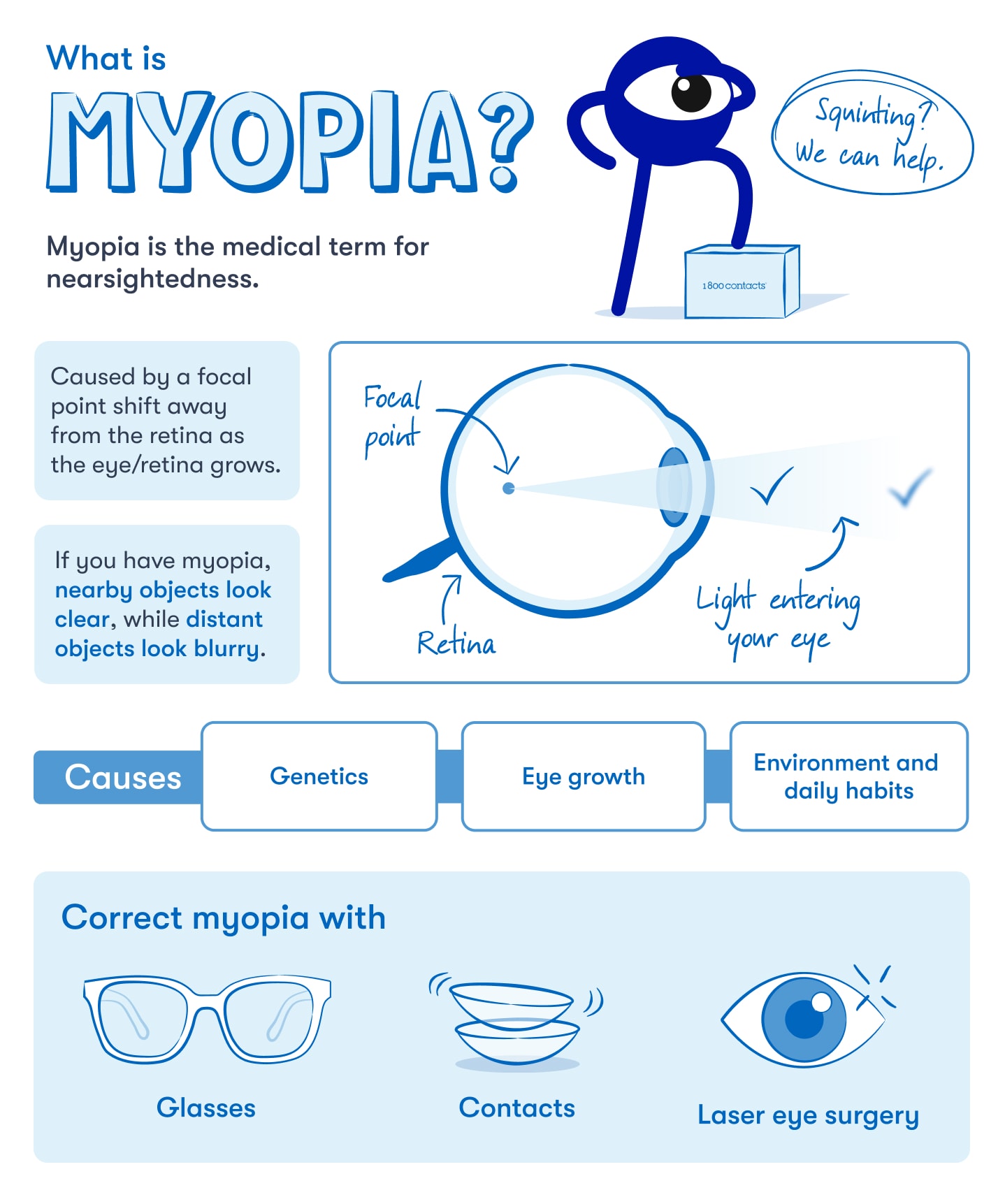
What is myopia?
Myopia is the medical term for nearsightedness.
If you're myopic, nearby objects tend to look clearer than distant ones.
You might notice that:
-
Your phone looks sharp and easy to read
-
Books and screens are clear up close
-
Road signs are blurry
-
The classroom board is hard to see
-
TV subtitles are difficult to read from across the room
-
Faces appear fuzzy at a distance
In simple terms:
-
Near = usually clear
-
Far = usually blurry
That's the classic sign of myopia.
You may also hear someone described as "myopic." While the word can also be used to describe short-term thinking in everyday conversation, we're talking about vision here.
How does a person with myopia see?
One of the easiest ways to understand myopia is to think about everyday situations.
A person with myopia may be able to:
-
Read a book comfortably
-
Scroll through social media without issue
-
Work on a laptop with little difficulty
At the same time, they may struggle to:
-
Read the kitchen clock from the hallway
-
See a presentation across a conference room
-
Check the scoreboard at a sporting event
-
Recognize someone waving from across a parking lot
The stronger the prescription becomes, the blurrier distant objects may appear without glasses or contact lenses.
Why does myopia happen?
To understand myopia, it helps to know a little bit about how the eye focuses light.
When vision is working normally, light enters the eye and focuses directly on the retina, the light-sensitive tissue at the back of the eye.
With myopia, the focus point lands slightly in front of the retina instead.
That creates blurry distance vision.
This usually happens because:
-
The eye is longer than average from front to back
-
The cornea is more curved than average
-
The eye bends light too strongly
Think of it like a camera slightly out of focus. The image reaches its sharpest point before it gets to the screen where it belongs.
What causes myopia?
The immediate cause of myopia is how the eye focuses light, but several factors may influence why someone develops it.
Genetics
Family history is one of the biggest factors.
If one or both parents are nearsighted, children are more likely to develop myopia as well.
Eye growth
Many cases develop naturally as the eye grows during childhood.
As the eye becomes longer, the focus point can shift, leading to nearsighted vision.
Environment and daily habits
Researchers continue to study how lifestyle factors may influence myopia progression.
Possible factors include:
-
Extended near work
-
Reading for long periods
-
Limited outdoor activity
No single activity automatically causes myopia, but these factors may play a role in how quickly it develops or progresses in some individuals.
Who tends to get myopia?
Myopia often begins in childhood and may continue changing through the teenage years.
Parents sometimes notice that a child:
-
Squints frequently
-
Sits very close to the TV
-
Struggles seeing the board at school
-
Experiences headaches after visual tasks
Adults can be nearsighted too, but many people are first diagnosed during their school-age years.
For some people, the prescription stabilizes in early adulthood. For others, it may continue changing over time.
Is myopia serious?
For most people, myopia is primarily a vision correction issue rather than a serious eye health problem.
When myopia is mostly a vision issue
Millions of people wear glasses or contact lenses to correct myopia every day.
Having a nearsighted prescription doesn't automatically mean you have an eye disease or that you're at risk of losing your vision.
For many people, myopia is simply a common error that can be corrected easily.
When myopia can carry more risk
Higher levels of myopia deserve a little more attention.
People with high myopia may also have a higher risk of:
-
Retinal detachment
-
Myopic macular degeneration
-
Other retinal complications
This doesn't mean those conditions will happen. It simply means regular eye exams become even more important as prescriptions increase.
Signs it's time for an eye exam
Many people don't realize their vision is changing until daily tasks become frustrating.
Consider scheduling an eye exam if you notice:
-
Blurry distance vision
-
Frequent squinting
-
Headaches
-
Eye strain
-
Difficulty driving
-
Trouble seeing presentations or whiteboards
-
Difficulty recognizing distant faces
Some symptoms require more immediate attention.
Contact an eye doctor promptly if you experience:
-
Sudden flashes of light
-
A large increase in floaters
-
A curtain-like shadow in your vision
-
Sudden vision loss
These symptoms aren't typical signs of routine myopia and should be evaluated quickly.
How is myopia corrected?
The goal of myopia correction is simple: move the focus point back onto the retina so distant objects appear clear.
Glasses
Glasses are one of the most common ways to correct myopia.
They redirect incoming light so it focuses correctly inside the eye.
For many people, glasses provide a simple, effective solution with minimal maintenance.
Contact lenses
Contact lenses work similarly, but they come into direct contact with the eye's surface (hence the name).
Many people choose contacts because they:
-
Provide a wider field of view
-
Don't fog up
-
Work well during sports and exercise
-
Eliminate the look/discomfort of glasses
The best option depends on your prescription, lifestyle, and personal preference.
Can myopia be cured?
This is one of the most common questions eye doctors hear.
The simple answer is, usually not without surgical correction.
Does myopia go away on its own?
In most cases, no.
Myopia does not typically disappear without treatment.
Can myopia be corrected?
Absolutely.
Glasses and contact lenses can provide clear vision by correcting how light enters the eye.
It's important to understand the difference between correction and cure.
When you wear glasses or contacts, your vision may be perfectly clear. But the eye itself is still naturally nearsighted underneath that correction.
What about LASIK and other procedures?
Some adults choose refractive surgery to reduce their dependence on glasses or contact lenses.
Common options include:
-
PRK
-
SMILE
These procedures reshape the cornea so that light focuses more appropriately on the retina.
While many patients achieve excellent results, surgery isn't right for everyone. An eye doctor can determine whether you're a candidate based on factors such as your prescription, age, and eye health.
Can myopia progression be slowed?
For children, there are now several approaches designed to help slow myopia progression.
You may hear about:
Low-dose atropine drops
Prescription eye drops sometimes used as part of myopia management programs.
Orthokeratology (Ortho-K)
Special contact lenses worn overnight to temporarily reshape the cornea.
Myopia-management contact lenses
Certain specialty contact lenses may help slow progression in some children.
These approaches aren't designed to "cure" myopia. Instead, they aim to reduce how quickly the prescription worsens over time.
The bottom line
Myopia is a very common vision condition that causes distant objects to appear blurry while nearby objects remain relatively clear.
For most people, myopia is easily managed with glasses, contact lenses, or other vision correction options.
The important thing to remember is that needing vision correction doesn't automatically mean something is wrong with your eye health. However, stronger prescriptions can carry additional risks, which is why routine eye exams matter.
Original publish date: 6/24/2022
Updated date: 9/23/2026