



Colored Contact Lenses
The easiest way to save on contact lenses®
Your complete guide to colored contact lenses
If you want to temporarily change your eye color, colored contact lenses offer a safe, customizable way to transform your look. Whether you’re after a subtle enhancement or a dramatic shift—from dark brown to brilliant green—colored contacts can help you achieve the look you’re after.
Colored contacts can seem overwhelming if you’re new to them. You may have questions: Do you need a prescription? How do they compare to clear lenses? Which brands look the most natural? Whether you need prescription lenses or just want them for cosmetic reasons, this guide covers what you need to know.
We’ll compare top brands like Air Optix Colors and Dailies Colors, explain daily vs. monthly lenses, cover essential safety tips, and show you how to choose and order colored contacts online.
How colored contacts work to change your eye color
Colored contact lenses mimic the appearance of your iris—the colored part of your eye. Your iris is made up of unique flecks, lines, and patterns, not just a flat color. The best colored contacts use advanced blending technology to replicate this natural complexity, making your eyes look vibrant and realistic.
The three main types of lens tints
There are three main types of tints in colored contacts:
- Visibility tints: These add a faint blue or green tint to the lens, only for handling. They do not affect eye color.
- Enhancement tints: These translucent tints intensify your existing eye color. They work best for people with light eyes who want more color vibrancy. Enhancement tints don’t work well on dark eyes.
- Opaque tints: These are solid colors that fully cover your natural iris. Opaque lenses are the go-to for people with dark eyes who want a noticeable color change.
Blending technology for a natural look
Modern colored contacts use layered colors and patterns, not just a simple ring of pigment. For example, a lens may have a darker rim, a colored midsection, and a lighter inner ring near the pupil. This creates natural depth and avoids a fake or “glass-like” look.
Prescription colored contacts vs. non-corrective lenses
A common question is if you can get colored contacts without a prescription. In the United States, the answer is no. All contact lenses—including non-corrective (plano) colored lenses—require a valid prescription from an eye care professional.
Do you need a prescription for colored contacts?
You need a contact lens prescription, even if you have perfect vision and only want colored contacts for cosmetic use. Your doctor will measure your eye’s curvature and size to ensure a proper fit. Ill-fitting lenses can cause discomfort, injuries, or infections.
If you don’t need vision correction, your doctor will prescribe plano lenses (no power) matched to your eye’s measurements.
Vision correction options
If you already wear contact lenses for myopia or hyperopia, most colored lens brands offer a wide range of powers. You can enjoy vision correction and an eye color change at the same time. Just enter your prescription details (power, base curve, and diameter) when you order, as you would with clear lenses.
Deep dive into Air Optix Colors
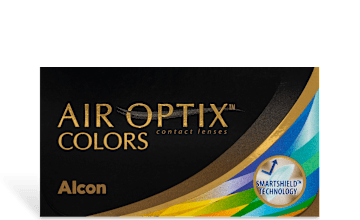
Air Optix Colors, from Alcon, are among the most popular monthly disposable colored lenses available. You wear the same pair daily for up to 30 days, removing them to clean and store them each night.
Breathability and comfort technology
These lenses are made of lotrafilcon B, a silicone hydrogel material that allows up to six times more oxygen to reach the eye compared to standard hydrogel. High oxygen flow helps keep your eyes comfortable and healthy, even after long hours of wear.
Air Optix Colors also use SmartShield technology, creating a thin protective layer on the lens that resists deposits from tears and keeps the lens feeling smooth and clear for the entire month.
Available shades and color options
Air Optix Colors uses 3-in-1 color technology (ColorBlends pattern), embedding color inside the lens. This keeps the pigment from touching your eye. The lineup includes 12 shades, ranging from subtle options like Pure Hazel, Blue, Green, Gray, and Brown to vibrant choices like Brilliant Blue, Gemstone Green, Sterling Gray, Honey, Amethyst, and Turquoise.
How long can you wear Air Optix Colors?
These lenses are approved for daily wear, not overnight use. You must remove them before sleeping and replace your lenses 30 days after opening the blister pack, even if you haven’t worn them every day.
Exploring Dailies Colors for everyday convenience
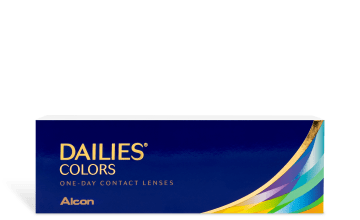
For maximum convenience, Dailies Colors provide the benefits of colored contacts in a daily disposable format. Also by Alcon, these lenses are worn once and thrown out at the end of each day.
The benefits of daily disposable colored lenses
Daily colored contacts are considered the healthiest and easiest option. You start each day with a fresh pair, eliminating the need for cleaning, storage, or lens cases. Because you use a new lens each day, buildup of proteins or allergens is minimized, making these lenses ideal for people with sensitive eyes or allergies.
Dailies Colors are made from Nelfilcon A (a hydrogel with high water content), providing excellent all-day comfort.
Shades available in the Dailies Colors line
Dailies Colors use a similar 3-in-1 blending technology as Air Optix Colors and feature four shades: Mystic Blue, Mystic Green, Mystic Gray, and Mystic Hazel. These shades can enhance both light and dark eyes with a noticeable, natural effect and help define your iris.
How to choose the right color for your eyes
Choosing the best shade depends on your natural eye color, skin tone, and hair color. Because colored contacts blend with your iris, the result varies from person to person.
Best colored contacts for dark eyes
If you have dark eyes, look for opaque tints—enhancement tints won’t show up. Both Air Optix Colors and Dailies Colors use opaque blending to cover dark brown eyes. For a natural change, try lighter brown or hazel tones (like Pure Hazel or Honey). For a bolder effect, shades like Gemstone Green or Sterling Gray offer dramatic, vibrant transformations.
Enhancing light and natural eye colors
If your eyes are already light (blue, green, gray), you have more options. Use enhancement tints for subtle depth, or go for opaque tints if you want to completely change your look. Cool tones like blue and gray suit cool skin tones; warm tones like hazel or green complement warm skin.
Daily wear vs. monthly disposable: Which is right for you?
Decide based on how often you’ll wear colored contacts, your routine, and your budget.
The case for single-use daily lenses
If you wear colored contacts occasionally (for events or weekends), daily disposables are best. You only use lenses when needed, so a box can last a long time. They’re also easiest for new wearers or anyone not wanting the upkeep of cleaning and storing contacts.
The case for monthly reusable lenses
If you’ll wear colored contacts every day, monthly lenses can be more cost-effective over time. They come in more colors and prescription options, but require a care routine and ongoing purchase of lens solution and cases.
Understanding astigmatism and colored lenses
Many people with astigmatism want to know if they can wear colored contacts. Astigmatism requires toric lenses to provide proper correction. At present, popular colored contacts such as Air Optix Colors and Dailies Colors are only available as spherical lenses, not toric.
If you have mild astigmatism, your doctor may prescribe a spherical colored lens if your vision remains acceptable. For moderate to high astigmatism, colored contacts may not provide clear vision. Some specialty manufacturers offer custom toric colored lenses, but these require a specific fitting and are typically more expensive. Always talk with your eye care provider about options for your prescription.
Safety, hygiene, and lens care basics
Colored contacts are safe when worn with a prescription and proper hygiene. Never share lenses. Stick to the wearing schedule and do not overuse lenses—daily disposables should never be reused, and monthly lenses must be replaced 30 days after opening.
Lens care tips for monthly colored contacts
For monthly lenses, use only fresh, quality lens solution to clean, rinse, and store them—never use tap water or saliva. Wash your hands before handling lenses. When removing, gently rub each lens with solution for about 20 seconds to remove deposits, then store in a clean case with new solution.
Visual considerations
In dim light, your pupils can become larger than the clear center of the colored lens, which may slightly impact peripheral vision. In bright light, your pupil is smaller and some of your natural eye color may show through. Most wearers don’t notice these minor shifts.
How to order colored contacts online
After your eye exam and prescription, ordering colored contacts online is straightforward. Compare prices, look for sales, and check for bundle deals or free shipping.
Reading your contact lens prescription
Your prescription includes your lens brand, power (SPH), base curve (BC), diameter (DIA), and any other specific notes. Both eyes may have different measurements, so double-check before ordering.
Finding safe, reputable websites
Legitimate retailers will always verify your prescription per U.S. law. If a website allows you to purchase contacts without verifying your prescription, avoid it—they may be selling unapproved or counterfeit lenses.
To get the best value, compare per-box pricing and pack sizes—for example, monthly lenses might be in a 6-pack (six months for one eye) and dailies in a 30- or 90-pack. Consider sites with subscription options or bulk discounts for convenience and savings.
By working with your doctor, following lens care guidelines, and choosing trusted brands like Air Optix Colors and Dailies Colors, you can enjoy a natural-looking, comfortable eye color change with confidence.