



Multifocal & Bifocal Contacts
The easiest way to save on contact lenses®
Understanding multifocal and bifocal contact lenses
If you find yourself holding your phone or reading materials farther away to see them clearly, you’re not alone. This common, natural part of aging is called presbyopia.
When presbyopia sets in, the lens inside your eye loses some flexibility, making it harder to focus up close. Reading glasses are a go-to fix, but many people find them inconvenient—especially if you have an active lifestyle or prefer not to wear frames. Multifocal and bifocal contact lenses are a helpful solution, allowing you to see well at all distances while keeping you glasses-free.
How do multifocal and bifocal contact lenses work?
The terms “multifocal” and “bifocal” are sometimes used interchangeably, but they have key differences. Bifocal contact lenses have two distinct zones—one for distance vision and one for near vision, similar to bifocal eyeglasses. Multifocal contact lenses feature multiple prescription strengths in one lens, helping you see clearly up close, at a distance, and at intermediate ranges (like a computer screen).
Manufacturers use a few design approaches to combine these powers within a single lens:
Concentric ring designs
In this design, the center of the lens typically holds the main viewing prescription (often your distance vision). Alternating rings of near and distance prescriptions surround the center, letting your eye naturally access the needed power depending on lighting and what you’re focusing on.
Aspheric or blended designs
Some multifocal lenses use a gradual change in prescription from the center to the edges—much like progressive eyeglasses. With these, your brain adapts to select the clearest image based on what you’re looking at and tunes out the rest.
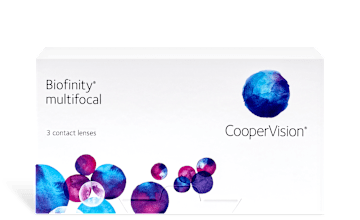
A closer look at Biofinity multifocal
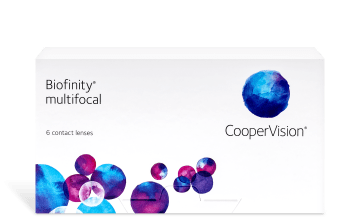
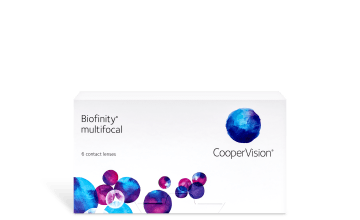
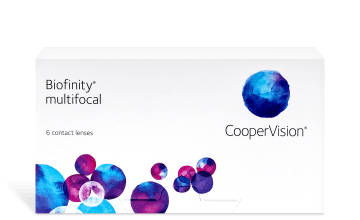
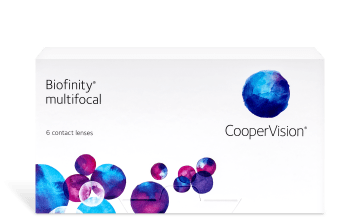
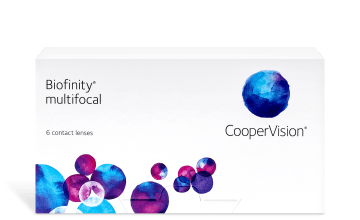
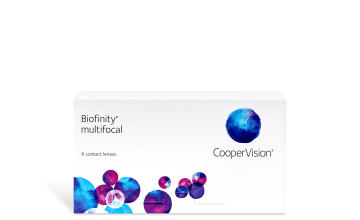
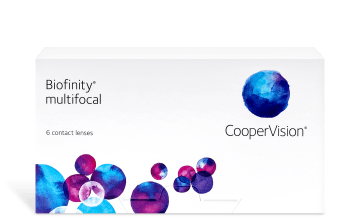
If you’re comparing brands, you’ll likely notice Biofinity multifocal by CooperVision. Eye care professionals frequently recommend these monthly lenses to people with presbyopia who want all-day comfort.
Biofinity multifocal uses Balanced Progressive Technology, which carefully distributes different prescription powers across the lens. This design helps you switch smoothly between nearby text, intermediate objects, and distant scenes.
A standout feature of these lenses is the Aquaform material. This naturally hydrophilic silicone hydrogel attracts and retains moisture, which helps keep the lenses comfortable all day—even if you’re prone to dryness. Biofinity multifocal lenses are designed for monthly replacement: you wear the same pair daily, cleaning and storing them at night for up to 30 days before replacing them.
What to expect during the adjustment period
Many new wearers ask, “Is there a trick to getting used to multifocal contacts?” The key is patience—give your eyes and brain time to adapt.
Your visual system needs to learn to process multiple images and choose the right focus. It’s normal during the first week or two to notice slight shadowing, ghosting, or mild glare—especially in low light. Wearing your new lenses consistently each day and reading in good lighting will help speed up adaptation. Most people feel comfortable within two weeks or less.
Advantages and disadvantages of multifocal lenses
The biggest advantage of multifocal contact lenses is convenience. You’ll be able to shift focus quickly—from your dashboard to the road, or from your smartwatch to a tennis ball—without swapping between different glasses or contacts.
The main trade-off is that overall sharpness may be a bit softer than what you’d get with dedicated single-vision lenses. Seeing through multiple powers at once means neither your distance nor your near vision will be as crisp as with glasses designed for just one range. Also, multifocal contacts tend to cost more than standard single-vision lenses due to their advanced design.
Ordering your multifocal prescription online
To purchase multifocal or bifocal contact lenses online, you’ll need a current prescription specifically written for these types of contacts. A regular eyeglasses or single-vision contact lens prescription won’t work.
Your eye doctor will take extra measurements to provide the correct details. In addition to your base curve (BC), diameter (DIA), and sphere (power), you’ll see an “ADD” power—this is the extra magnification needed for reading. Some brands, including Biofinity multifocal, may also require your doctor to indicate whether the lens is for your dominant (D) or non-dominant (N) eye, as the lens design is customized for each to provide the best clarity across all distances.
By understanding your prescription and giving yourself time to adjust, you can confidently switch to multifocal lenses and enjoy the freedom of clear, comfortable vision—no reading glasses required.