Glasses for high prescriptions: how to get thinner, lighter lenses
A strong prescription means thick glasses lenses, right? If you’re worried about “coke-bottle” glasses, you’re not alone. The good news about modern glasses is that you don’t have to settle for thick lenses if you don’t want to.
Lens thickness isn’t decided by prescription strength alone. In this article, we’ll dive into what contributes to lens thickness—like frame size, lens material, lens design, and your prescription of course—and how to find the best glasses for you when you have a higher prescription.
What counts as a high prescription?
A +4.00 may seem like a high number, but it’s actually considered moderate. There isn't one official definition of a high prescription, but lenses tend to look visibly thicker when a prescription reaches ±3.00. The following ranges are a useful aid to break it down even further:
-
Mild prescription: up to about ±3.00
-
Moderate prescription: approximately ±3.00 to ±6.00
-
High prescription: approximately ±6.00 and higher
-
Very high prescription: often ±8.00 to ±10.00 and above
The higher your prescription, the thicker your lens needs to be to correct your vision. At moderate levels and higher, choosing a high-index lens becomes a better option. This is because higher-index lenses both reduce weight, which improves comfort, and opens up more options for frame styles (and who doesn’t love options!).
Higher-index lenses also appear visibly less thick, a boon for anyone preferring a slimmer lens aesthetic.
Why some prescription lenses look thicker than others
Many people are surprised to discover that two people with the same prescription can end up with glasses that look very different. It's kind of like how one secret family lasagna recipe tastes totally different from another's. Both are lasagna, but the ingredients are slightly different.
When it comes to lenses, the following ingredients all impact the final appearance:
-
Prescription strength
-
Astigmatism correction
-
Lens material
-
Frame size
-
Frame shape
-
Pupillary distance and lens positioning
Just like how lasagna noodles alone don’t make a full cheesy, delicious lasagna, prescription strength matters, but it's only one piece of the puzzle.
Nearsighted vs farsighted lenses
Did you know that thicker lenses aren’t the same thickness throughout? They’re actually curved, bending light at different rates to bring a blurry world into perfect focus.
Nearsighted prescriptions (minus lenses) and farsighted prescriptions (plus lenses) use opposite curves to achieve that crisp focus.
Minus lenses are typically thinner in the center and thicker at the edges. That’s why larger frames tend to make lenses for myopia noticeably thicker.
For people with hyperopia, lenses tend to be thicker in the center and thinner at the edges. For nearsighted folk, center thickness becomes a primary concern for comfort. After all, it’s pretty distracting to have your eyelashes collide with your glasses at every blink.
What lens materials are thinnest?
For most people with high prescriptions, choosing a higher-index lens will be the thinnest option. But deciding what index—yep, there are different levels of high index—can be tough to decide due to cost and perceivable thickness.
High-index lenses use different lens materials to bend light more efficiently. Basically, the higher the index, the thinner a lens needs to be to bend the same amount of light. That’s why high-index lenses are thinner and lighter for the same prescription. (For our ultra-nerdy deep dive, we did a whole blog just about high-index lenses.)
Here’s our quick and dirty breakdown of lens indexes:
Standard plastic lenses
Standard lenses are the go-to for lower prescriptions, and they’re also the most cost-effective type of lens. Once a prescription gets higher than ±3.00, standard lenses tend to get thicker and heavier, creating that signature “magnifying glass” appearance.
Pros:
-
Lower cost
-
Good optical quality
Cons:
-
Thicker for stronger prescriptions
-
Heavier than high-index options
1.67 high-index lenses
Many glasses wearers with prescriptions above ±3.00 choose 1.67 high-index lenses over standard ones. These lenses are about 30% lighter and thinner than standard, but they tend to cost a bit more.
Pros:
-
Noticeably thinner than standard plastic
-
Lighter weight
-
Often the best balance of cost and appearance for moderate to high prescriptions
Cons:
-
More expensive than standard lenses
1.74 high-index lenses
This type of lens is generally reserved for ultra-high prescriptions. While they’re the thinnest and lightest, they’re also the most expensive.
Pros:
-
Typically the thinnest commonly available lens option
-
Can significantly reduce lens edge thickness, so ideal for nearsighted folks wanting larger frames
Cons:
-
Higher cost
-
The visual difference compared to 1.67 may be modest for some prescriptions
Is 1.67 or 1.74 best for high prescriptions?
For most people with moderate to high prescriptions, 1.67 high-index lenses provide the best overall balance of thinness, weight, appearance, and cost. For very strong prescriptions, 1.74 lenses may be worth considering.
You may be thinking, “why not just upgrade to 1.74, even if my prescription’s on the lower end?” While 1.74 high-index lenses are thinner than 1.67 lenses, the difference can be hard to see below -8.00 or +6.00. That may mean the cost is the only noticeable difference for some wearers.
As you consider lens options, don't overlook frame selection. A better frame choice often delivers more visible improvement than a lens upgrade alone (more on that soon, promise).
Evaluating lens material and frame selection together rather than treating them as separate decisions can bring the decision into focus, (pun totally intended).
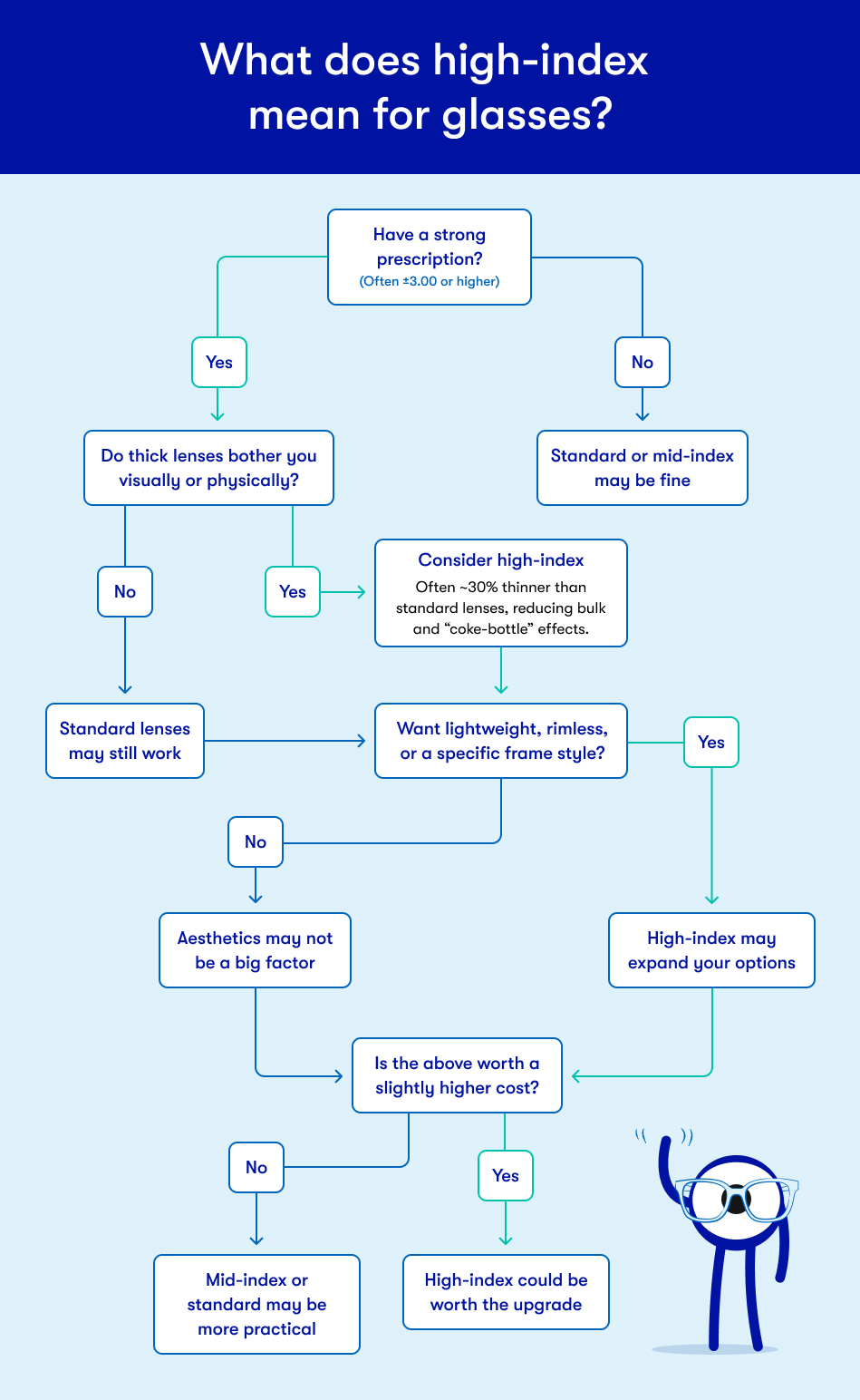
Lens upgrades for high prescriptions
Lens material isn't the only factor that affects the appearance of your glasses. These upgrades definitely help with your glasses’ overall aesthetic, and they tend to improve your experience wearing your glasses, too.
Anti-reflective coating
High-index lenses reflect more light than standard lenses, which can cause glare and other nuisances for wearers.
Anti-reflective coatings reduce glare, improve nighttime comfort, and make your eyes more visible through the lenses.
Scratch-resistant coatings
High-index lenses are a bit like that friend who’s just a little clumsy (kudos if it’s you!). The special materials that make them extra efficient at bending light also make them prone to scratches. Scratch-resistant coatings help protect your lenses and extend their wearability.
If you’re already spending a bit more on a high-index lens, choosing a scratch-resistant coating helps make the most of that investment.
Aspheric lenses
While high-index lenses use different materials to refract light more efficiently, aspheric lenses use flatter curves. This altered design creates a slimmer profile while minimizing certain distortions. The cool thing about aspheric lenses is that they can team up with high-index materials, further reducing the bulky appearance of ultra-high prescriptions.
How frame size affects lens thickness
Wondering what type of glasses frames look best if you have a high prescription? You might be surprised to learn that frame choice can affect lens appearance almost as much as lens material.
If you’re hoping to minimize the appearance of thicker lenses, a few frame characteristics work especially well with higher prescriptions.
Smaller frames
A quick lens design recap: lenses use continuous curves to bend light, which means lenses are thinner in some parts and thicker in others.
For a nearsightedness prescription, the lens is thickest at the rim. The larger the frame, the thicker the lens gets at the edges. Choosing a smaller frame requires less material overall, resulting in thinner lens edges and a lower weight, even without high-index lenses.
Round or oval shapes
Rounder shapes keep the lens edges more consistent and often reduce maximum edge thickness.
Full-rim frames
Full-rim frames help conceal lens thickness better than rimless or semi-rimless styles.
Acetate frames
Thicker acetate frames can hide lens edges better than ultra-thin metal frames. Many people with strong prescriptions prefer acetate for this reason alone.
What glasses are best for high prescriptions?
Because everyone’s eyes are special and unique, there’s no universal formula for finding the perfect glasses (sorry!). We hope this little shortcut helps.
Best for the thinnest look
-
1.74 high-index lenses
-
Smaller frame
-
Full-rim acetate frame
-
Anti-reflective coating
Best for value
-
1.67 high-index lenses
-
Moderately sized frame
-
Anti-reflective coating
Best for all-day comfort
-
High-index lenses
-
Lightweight frame materials
-
Proper fit and nose support
Best for progressive lenses
-
Appropriate frame height
-
High-index lenses when needed
-
High-quality progressive lens design
The bottom line
The best glasses for high prescriptions aren't just about choosing the highest-index lens available.
The thinnest, lightest, most comfortable, and most “you” result usually comes from a combination of factors:
-
The right lens material
-
A modest frame size
-
A frame shape you love
-
Appropriate coatings and lens design
For many people, a well-chosen 1.67 lens in a properly sized frame can outperform a more expensive lens paired with the wrong frame.
When shopping for glasses with a strong prescription, focus on the entire package rather than any single upgrade. That's usually the fastest path to glasses that look better, feel lighter, and fit your budget.
Looking for glasses that work with a strong prescription?
The Framery offers a variety of frame styles and lens options, including high-index lenses designed for stronger prescriptions. Whether your goal is the thinnest possible profile, all-day comfort, or a balance between appearance and budget, comparing frame size and lens material together can help you find a pair you'll actually enjoy wearing every day.