Single vision vs. progressive lenses
If you’re shopping for prescription glasses, you’ve likely come across the terms single vision lenses and progressive lenses. Understanding the difference between these lens types can help you choose glasses that feel comfortable and meet your vision needs—both now and in the future.
This guide explains what single vision and progressive lenses are, how progressive lenses work, and the key differences between them. It also covers pros and cons, cost considerations, and who each lens type is best for, so you know what to ask your optometrist or eyewear retailer.
What are single vision lenses?
Single vision lenses are prescription lenses with one consistent optical power across the entire lens. This means they correct vision at a single distance only.
Single vision lenses are commonly used to correct:
-
Nearsightedness (myopia), which affects distance vision
-
Farsightedness (hyperopia), which affects near vision
-
Astigmatism, which causes blurred or distorted vision at all distances
Because the prescription is uniform, single vision lenses tend to be easy to adapt to and provide clear, predictable vision in their intended range.
What does single vision lens mean in everyday use?
In everyday terms, single vision lenses are designed for one primary task. Some people wear them all the time, while others use them only for specific activities.
Examples include:
-
Glasses for distance vision, such as driving, watching TV, or attending school
-
Reading glasses for close‑up tasks
-
Computer glasses optimized for screen distance
If you need correction for both near and far distances, single vision lenses usually require switching between different pairs of glasses.
Can I wear my single vision glasses all the time?
Yes, as long as the prescription meets your daily needs. Many people wear single vision lenses full‑time for distance vision.
However, if you develop presbyopia (an age‑related condition affecting close-up vision) single vision distance glasses may no longer work well. At that point, you may need reading glasses or a different lens type.
What are progressive lenses?
Progressive lenses are multifocal lenses designed to correct vision at multiple distances in one pair of glasses. This includes distance, intermediate, and near vision.
The term progressive lenses refers to the gradual change in lens power from the top of the lens to the bottom, without visible lines.
Progressive lenses are commonly prescribed for people with presbyopia, which typically begins in the early to mid‑40s and makes it harder to focus on nearby objects.
Progressive lenses meaning and how they work
Progressive lenses work by dividing the lens into different vision zones:
-
The top portion is for distance vision
-
The middle portion is for intermediate vision, such as computer use
-
The bottom portion is for near vision, such as reading
Instead of sharp jumps between powers, the prescription gradually changes as your eyes move down the lens. This allows for smoother transitions between distances and a more natural visual experience.
What is the purpose of progressive lenses?
The main purpose of progressive lenses is to provide clear vision at multiple distances without having to switch between glasses.
They are designed to:
-
Replace bifocals or reading glasses
-
Provide a more natural viewing experience
-
Offer a line‑free appearance
For many people, progressive lenses become an all‑day solution once close-up vision starts to decline.
What is the difference between a progressive lens and a normal lens?
A “normal” lens usually refers to a single vision lens.
The key difference is functionality:
-
Single vision lenses correct vision at one distance
-
Progressive lenses correct vision at multiple distances in one lens
This difference affects comfort, adaptation, appearance, and cost, which are important factors when choosing between the two.
Difference between single vision and progressive lenses
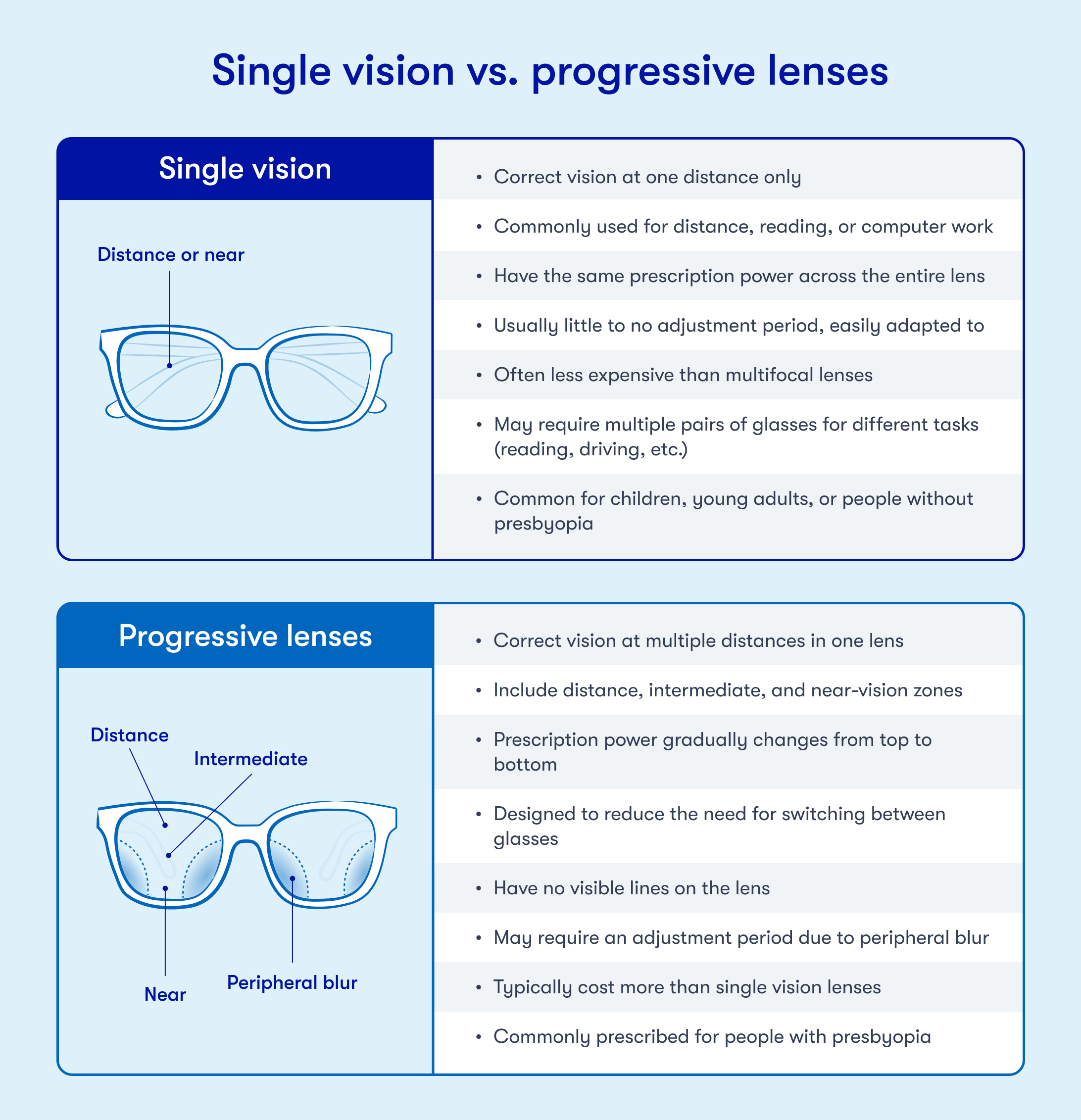
Single vision and progressive lenses serve different vision needs and are designed to be used in different ways. The lists below break down what each lens type does and who they’re typically best for.
Single vision lenses
-
Correct vision at one distance only
-
Commonly used for distance, reading, or computer work
-
Have the same prescription power across the entire lens
-
Usually easy to adapt to with little or no adjustment period
-
Often less expensive than multifocal lenses
-
May require multiple pairs of glasses for different tasks
-
Common for children, young adults, or people without presbyopia
Progressive lenses
-
Correct vision at multiple distances in one lens
-
Include distance, intermediate, and near vision zones
-
Prescription power gradually changes from top to bottom
-
Designed to reduce the need for switching between glasses
-
Have no visible lines on the lens
-
May require an adjustment period due to peripheral blur
-
Typically cost more than single vision lenses
-
Commonly prescribed for people with presbyopia
Is progressive lens better than single vision?
Neither option is universally better. The right choice depends on your vision needs, age, daily activities, and comfort preferences.
Progressive lenses may be better if:
-
You need help seeing at multiple distances
-
You want one pair of glasses for most activities
-
You prefer not to switch between glasses
Single vision lenses may be better if:
-
You only need correction at one distance
-
You are not ready for multifocal lenses
-
You want a simpler, lower‑cost option
Do I need progressive lenses or single vision lenses?
This is a common question, especially for people noticing changes in near vision.
You may be a good candidate for single vision lenses if:
-
You have no trouble reading or using a phone
-
Your prescription corrects only distance or near vision
-
You are younger or not experiencing presbyopia
You may benefit from progressive lenses if:
-
You struggle with reading small print
-
You remove your glasses to see up close
-
You use multiple pairs of glasses during the day
An eye care professional can help determine which option fits your vision and lifestyle.
How do I know if I’m supposed to wear single vision or progressive lenses?
Your prescription will indicate whether your lenses are single vision or progressive.
Signs you may need progressives include:
-
Holding reading material farther away
-
Eye strain during close work
-
Frequent switching between glasses
An eye exam is the best way to confirm what type of lens you need.
Pros and cons of progressive lenses
Advantages of progressive lenses
-
Clear vision at multiple distances
-
One pair of glasses vs. multiple pairs
-
No visible lines on the lenses
Downsides of progressive lenses
-
Peripheral blur, especially at first
-
A learning curve during the adjustment period
-
Higher cost than single vision lenses
Most people adapt within a few weeks, but some may take longer.
Who should not wear progressive lenses?
Progressive lenses may not be ideal for everyone.
They may not be the best choice if:
-
You need very wide peripheral vision for specific tasks
-
You have difficulty adapting to visual changes
-
You only need vision correction at one distance
Some occupations and hobbies may be better suited to task‑specific single vision lenses.
What are the disadvantages of single vision lenses?
Single vision lenses are simple, but they have limitations.
Potential drawbacks include:
-
Needing multiple pairs of glasses
-
Inconvenience when switching between tasks
-
Limited usefulness once presbyopia develops
For people with changing vision needs, single vision lenses may no longer be enough on their own.
Who should wear single vision lenses?
Single vision lenses are well‑suited for:
-
Children and young adults
-
People with stable distance or near prescriptions
-
Those who prefer simple eyewear solutions
They are also commonly used as backup glasses or for specific tasks.
Which is better, bifocal or progressive lenses?
Both bifocals and progressive lenses correct multiple vision distances.
The main difference is how they transition:
-
Bifocals have a visible line separating distance and near vision
-
Progressive lenses offer a smooth, line‑free transition
Many people choose progressive lenses for their appearance and smoother vision changes, while others prefer the clear separation of bifocals.
What is better, progressive or bifocal?
This depends on personal preference.
Progressive lenses:
-
Look more like standard glasses
-
Provide intermediate vision for computer use
Bifocals:
-
Have distinct viewing zones
-
May feel easier to adjust to for some wearers
Your eye care provider can help you decide based on comfort and daily activities.
What is the difference between progressive lenses and Transitions® or photochromic lenses?
These two terms are often confused, but they describe different features.
-
Progressive lenses refer to how the prescription works across distances
-
Transitions® or other photochromic lenses refer to lenses that darken in sunlight
A single pair of glasses can be both progressive and photochromic.
How to choose between single vision, progressive, and other lens types
When choosing lenses, consider:
-
Your age and vision changes
-
How often you switch between near and far tasks
-
Work and screen habits
-
Budget and insurance coverage
Talking through your daily routine with an optometrist can help narrow the best option.
Cost considerations for single vision vs progressive lenses
Single vision lenses generally cost less than progressive lenses.
Progressive lenses may cost more due to:
-
Complex lens design
-
Custom fitting and measurements
-
Additional vision zones
While progressives often have a higher upfront cost, they may replace multiple pairs of single vision glasses (and cut down on lost pairs, you know who you are).
What to ask your optometrist or eyewear provider
Helpful questions include:
-
Which lens type fits my lifestyle best?
-
How long will adaptation take?
-
Are there different progressive designs available?
-
What options fit my budget?
Clear communication can help ensure you’re satisfied with your lenses.
Did you know you can order contacts online?
Say goodbye to trips to the eye doctor and hello to convenience! With 1-800 Contacts, you can easily order your contact lenses online and have them delivered straight to your door. Plus, our online vision exam makes it simple to get the prescription you need without leaving home. And the best part? You’ll save money on your first order with 1-800 Contacts. It’s never been easier to get your contacts!