


Why are contacts so expensive?
If you've ever wondered why contacts are so expensive, well, you're not alone. Compared to the one-time cost of glasses, contact lenses require ongoing care and maintenance, along with precision manufacturing, eye exams, and regular replacement. Together, these expenses can really add up.
This guide explains why contacts are so expensive, which types tend to cost more, and how to find options that fit your budget. For many people, the convenience of contacts is well worth the higher cost.
Why are some contacts more expensive than others?
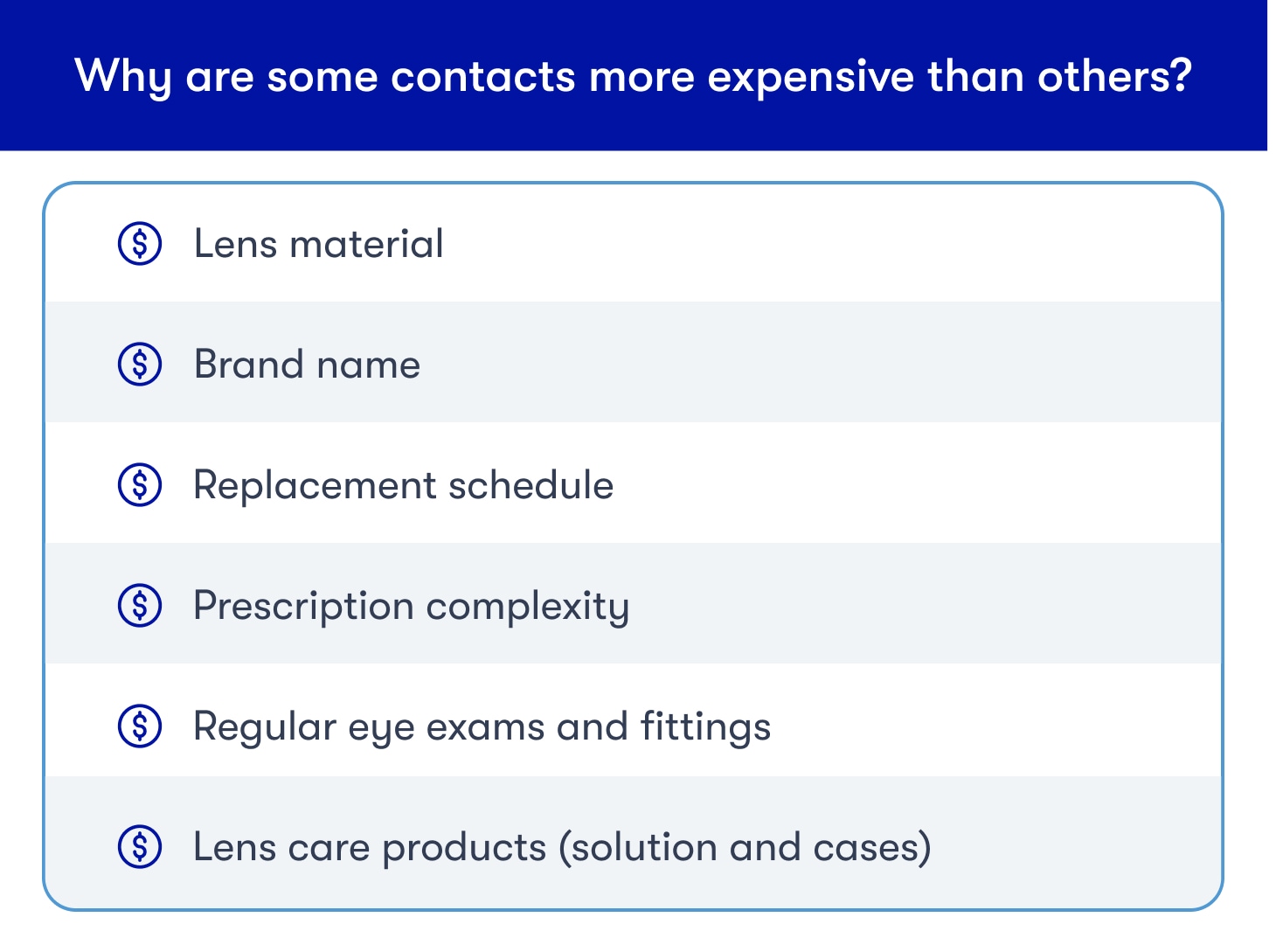
Some contacts cost more than others due to lens type, brand, replacement schedule, or prescription complexity. Basically, not all lenses are the same, and each type has its pros and cons. Here's why some lenses are more expensive:
- Lens material. Standard contacts are made with hydrogel, a material that absorbs large amounts of fluid to help keep your eyes feeling hydrated and comfy. And to boost moisture even further, some manufacturers use an advanced version called silicone hydrogel instead. Silicone hydrogel allows more oxygen to reach your corneas, increasing comfort during long wear. Advanced materials are more expensive, so silicone hydrogel contacts cost more.
- Brand name. Major brands often cost more than generic options, even when the features are the same. It takes money to advertise those brand names, and those costs do get passed on to you.
- Replacement schedule. If you wear daily disposables, you get a fresh, clean lens each day. However, you also have to buy more contacts per year than with monthly lenses, which usually results in a higher cost. Switching to AquaSoft Daily could save daily lens wearers hundreds each year.
- Prescription complexity. Some people require specialty lenses to correct their vision. For example, you might need toric lenses if you have astigmatism, an abnormal curvature of the eye. Specialty lenses require precision manufacturing, which makes them more expensive to produce.
When calculating the total cost of contacts, don't forget to include an eye exam in your budget. Your vision changes over time, so you need regular exams to ensure your prescription always matches your current needs. If you've ever wondered how much contacts cost, this guide breaks it down nicely.
Why are daily contacts more expensive?
Daily contacts cost more than monthly contacts because you use a fresh pair every day. It's kinda like buying socks. You wouldn't buy just one pair and wear them day in and day out (at least, we hope not).
This answers a big question many people have: Are daily contacts more expensive than monthly? On paper, yes. So, why are daily contacts so expensive? It all comes down to convenience (which is worth its weight in gold). There's no need to purchase a storage case or soak your lenses in solution. Best of all, there's a lower risk of protein buildup, so daily contacts often come with less eye irritation.
Here's a pro tip to help you keep your costs low: Buying daily contacts in bulk (think a year's worth instead of a month's worth) often reduces the price per box. Your wallet will thank you for planning ahead.
Why are astigmatism contacts so expensive?
Toric lenses for astigmatism cost more than standard contacts because their designs are more complex. When you have astigmatism, your eye is somewhat football-shaped rather than round, which distorts your vision. Toric lenses are precision-weighted to keep them in place, which makes them more expensive to produce.
Because toric lenses require specialized manufacturing, not all contact lens companies make them. This limits competition and keeps prices higher. Your economics teacher was right: Less competition + more complexity = higher costs for consumers.
Why are colored contacts so expensive?
Colored contacts cost more than standard lenses because they require an additional layer of pigment applied to the lens without compromising oxygen flow or comfort. Basically, colored contact lenses have to be both functional and fashionable. When a lens pulls double duty, you can expect to pay a bit more.
Here's why colored contacts are more expensive than other varieties:
- Extra manufacturing steps
- Strict safety and quality standards
- Prescription requirements
In the United States, colored contact lenses are considered medical devices and are regulated by the Food & Drug Administration (FDA). Buying cheaper, nonprescription contacts may seem like a great way to save money—but you get what you pay for. Getting contacts from unverified sources that don't comply with FDA requirements can pose serious risks to your eye health.
The bottom line? It's fine to cut corners on T-shirts and flip-flops, but not when you're buying something that goes in your eyes. You don't have to buy the most expensive contact lenses, but you should make quality a priority.
How to find inexpensive contacts online
Buying online is one of the most reliable ways to reduce your costs without compromising on quality or brand. Online retailers typically offer lower prices on contacts than eye doctor offices and brick-and-mortar stores because they have lower overhead and place bigger orders.
You can save even more by following these steps:
- Buy a year's supply at once. Buying in bulk often reduces the unit cost of contact lenses.
- Use your vision insurance or flexible spending funds. These options reduce your out-of-pocket costs, making contacts more affordable. We can look up any vision insurance benefits for you, no insurance card needed.
- Browse 1-800 Contacts for your preferred brand. We often hear people ask, "Why is 1-800 Contacts so expensive?" The truth is, 1-800 Contacts offers competitive prices compared to in-office purchases and other online retailers that may charge hidden fees (eww). You also get free shipping, a best-price guarantee, and the ability to apply your vision insurance at checkout.
- Schedule an online vision exam. The 1-800 Contacts online vision exam costs significantly less than a traditional in-office exam, reducing the total cost of contact lenses for eligible patients often by $100 or more.
Here are just a few of the affordable contact lens options available on our website:
- ACUVUE® OASYS® 1-Day for Astigmatism: These toric contacts cost less than $1.60 per lens, making them a great value for users with astigmatism.
- DAILIES® AquaComfort Plus: If you're looking for an inexpensive daily disposable, you can't go wrong with DAILIES AquaComfort Plus. When you purchase a 90-day supply, the cost is often less than $1 per day.
- Biofinity: At less than $11 per lens, Biofinity contacts are an affordable option for users who prefer monthly disposables.
Are contacts worth the cost?
Yes, contacts are worth the cost, especially when compared with the alternative. There is a convenience factor, but contacts cost what they do for legitimate reasons, from precision manufacturing to healthy replacement schedules. But with the right buying strategy, the annual cost is manageable for most wearers.
Remember, these factors affect the cost of contacts:
- Lens type and brand
- Specialty manufacturing requirements
- Order size
- Availability of insurance benefits, rebates, or HSA/FSA funds
For most wearers, the convenience, comfort, and visual freedom that contacts provide make the cost worthwhile. Once you have a fitting exam and get your prescription, use 1-800 Contacts to save even more.
Did you know you can order contacts online?
Since 1995, we’ve fought for a better way to buy contacts for you, the customer. No longer tied to higher brick-and-mortar costs, you can easily order your exact contact lenses online and get them delivered to your door. Our online vision exam makes it simple to get the prescription you need without leaving home. And the best part? You’ll save instantly on your first order with 1-800 Contacts. It’s never been easier to get your contacts!