


What are UV-blocking contact lenses?
UV-blocking contact lenses help shield your eyes from harmful UVA and UVB rays. They provide an extra layer of sun protection, which can help you keep your eyes healthy for the long haul.
But that doesn't mean you should get rid of your shades. UV-blocking contacts aren't a substitute for sunglasses — they make them more effective by helping to block sunlight that sneaks in around the frames. If you spend a lot of time outside, stronger sun protection is a must.
Before you make the switch to contacts with sun protection, it's helpful to understand more about them. In this guide, we explain what UV-block contacts are, how they work and highly-rated options.
Sun-blocking contact lenses vs. UV-blocking contacts
Sun-blocking contacts and UV-blocking contacts are essentially the same — they both reduce the amount of UV rays that reach the center of your eye. Some brands use these terms interchangeably.
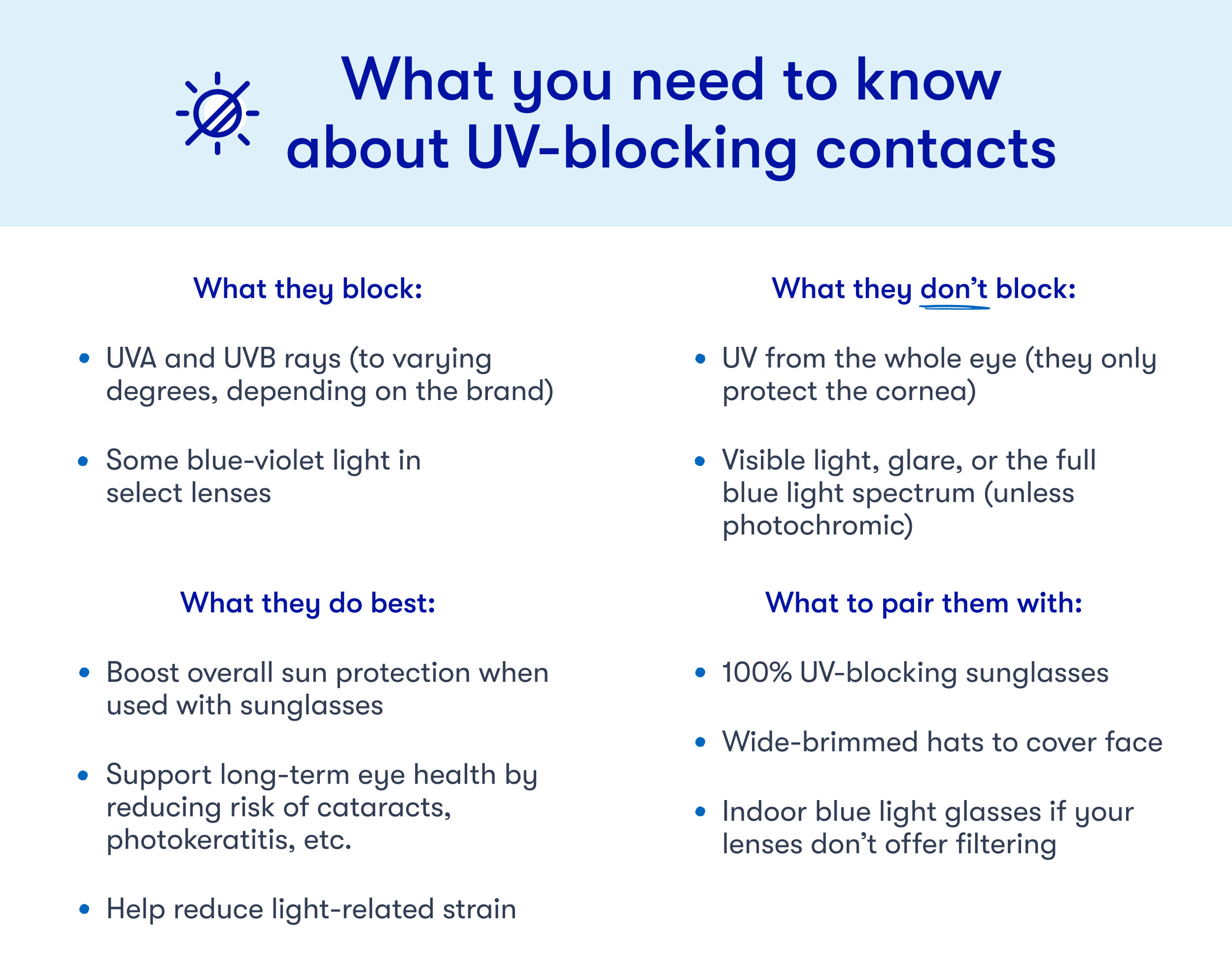
No matter what type of UV protection contact lenses you choose, it's still important to wear sunglasses when outside. UV-blocking contacts only protect part of your eye, leaving the whites exposed. Sunglasses cover your eyes and the delicate skin surrounding them.
So why bother using UV-blocking contacts at all? Even if you're wearing sunglasses, sunlight can still get to your eyes from the edges of the frames. Lenses with UV protection act as another line of defense, shielding the most delicate part of your eye from the sun's rays.
The combination of sunglasses and UV-blocking lenses helps reduce sun exposure that can cause a range of conditions, including growths and cancer. It can also make your eyes age faster, which means you could get cataracts earlier in life. (And you definitely don't want that!)
Certain types of sunglasses with UV protection can also block other components of sunlight, such as visible light, glare, and blue light. This helps you see more clearly when you're outside and eases any eye strain.
How UV-blocking contacts work
UV-blocking contacts are made with compounds that absorb UV rays. When sunlight hits them, these substances prevent UV radiation from reaching your eyes.
Every manufacturer has a proprietary (e.g., super secret) design. The amount of UVA and UVB rays that a lens blocks depends on how it's made and which compounds it uses.
For example, all ACUVUE® lenses are designed to block at least 97% of UVB and 82% of UVA radiation. Certain contacts from Clariti™ also offer UV-blocking, but they typically block a lower percentage of UVA and UVB rays.
Do UV-blocking contacts change color?
Some UV-blocking contacts change color, but usually only if they're light-responsive. This type of contact, which is also called a photochromic lens, works differently than regular UV-blocking lenses. When UV light hits the lens, it gets darker. The darker color filters visible light, reducing the amount that hits your eyes. (Ah, sweet relief.)
Even with this unique (and futuristic) feature, the darker lens protects only the part of your eye that it covers. Even if you're wearing contacts such as ACUVUE Oasys with Transitions, you still need to pair them with sunglasses for full sun protection.
Do UV-blocking contacts block blue light?
Certain UV-blocking contacts block blue light, but not all of them. These lenses work like blue light glasses — they use a coating to filter part of the blue spectrum. Many types are just as effective at reducing the issues that come from staring at screens, including eye strain, blurry vision, and sleep problems.
If you spend a lot of time in front of your phone or computer (who doesn't?), you might want to check out ACUVUE Oasys Max 1-Day lenses. They offer exceptional UV protection and blue light blocking.
Contacts with UV protection
Some of the best contacts with UV protection include products from brands such as ACUVUE, Clariti, and BioTrue®. Here are some top options:
-
ACUVUE Oasys Max 1-Day
-
ACUVUE OASYS 1-Day for astigmatism
-
Clariti 1-Day
-
BioTrue ONEday
-
ACUVUE 2
Curious about which contacts will work for you? Let's take a closer look.
ACUVUE Oasys Max 1-Day
Best for: People who spend lots of time outside and in front of screens
If you're constantly running between the great outdoors and your office, ACUVUE Oasys Max 1-Day daily contacts are a great option. They're made with ACUVUE's OptiBlue light filtering, which blocks about 60% of blue-violet light, and their TearStable™ Technology keeps your eyes feeling hydrated.
ACUVUE OASYS 1-Day for astigmatism
Best for: People with astigmatism
When you spend lots of time outside, ACUVUE OASYS 1-Day for astigmatism lenses are a great option. They have the highest level of UV protection available in contacts, blocking 90% of UVA rays and 99% UVB rays, so you can rest assured that you're supporting your long-term eye health. These dailies use HydraLuxe® technology to mimic your natural tears and offer all-day moisture.
Clariti 1-Day
Best for: People who want all-day comfort
When it comes to comfort, these daily contacts deliver. Clariti 1-Day lenses are made with the AquaGen™ process and excellent oxygen permeability, which means your eyes stay hydrated all day. Built-in UV blockers help keep UVA and UVB rays away from your eyes.
BioTrue ONEday
Best for: People who want maximum moisture
BioTrue ONEday contacts mimic your eyes' natural biological processes, so they retain moisture from morning until night. When you're outside, the UV Block technology keeps harmful radiation out of your eyes, and High Definition Optics reduce glare for clearer vision. These lenses are designed for daily use.
ACUVUE 2
Best for: People who want longer-wearing contacts with UV protection
If you want UV protection but don't want to put in a new pair of contacts every day, ACUVUE 2 could be the right fit. These soft hydrogel lenses last for up to 2 weeks — just toss them in your favorite contact solution for cleansing and safe storage. Built-in UV blocking adds some extra protection, whether you're sitting by a window or heading to the beach.
Are UV-blocking contacts worth it?
UV-blocking lenses can help increase sun protection to improve your long-term eye health. If you're looking for an alternative to sunglasses, these contacts probably won't cut it. However, they're a great addition to your sun-protection routine. Pair them with great UV-blocking glasses, and you may reduce your risk of health conditions ranging from cancer to cataracts.
Has your eye care professional recommended UV-blocking contact lenses? Visit 1-800 Contacts to shop online for the brand they prescribed.
Did you know you can order contacts online?
Say goodbye to trips to the eye doctor and hello to convenience! With 1-800 Contacts, you can easily order your contact lenses online and have them delivered straight to your door. Plus, our online vision exam makes it simple to get the prescription you need without leaving home. And the best part? You’ll save money on your first order with 1-800 Contacts. It’s never been easier to get your contacts!
Original published date: 1/24/2020
Updated: 12/15/2025