


How long can you wear contact lenses?
You're here because you're wondering, "How long can you wear contact lenses for?" It's been a long day, your eyes are starting to feel dry or irritated, and you've just had the realization that every contact lens wearer has had at some point. Maybe these foreign objects in my eyes have a daily limit before they become dangerous. After all, even too much exercise can be bad for you.
On average, people can wear contact lenses for between 8 and 16 hours a day. Your specific timeframe will depend on factors such as the type of contact lens, how well you tolerate them, and your eye health.
How long can you wear contact lenses?
So, how long can contacts be worn? There are two answers: one for the number of hours per day and one for the time period before they require replacement.
Overall, no matter the type of contact you wear (dailies, bi-weeklies, monthlies), you shouldn't exceed 16 hours a day. Even the most comforting and hydrating contacts will begin to feel uncomfortable after 16 hours. Embrace the sexy librarian look and switch to glasses when you reach that limit.
The other limit is how many days you can reuse your contact lenses before they need to be replaced.
Below is a handy cheat sheet, but keep reading below for the full story.
-
Standard contacts (daily wear): Around 12–16 hours per day
-
Dailies: One-time use and can usually up to 14–16 hours if your eyes are comfy
-
Night contacts (extended wear): Up to 7–30 nights of continuous wear (only if the lens is approved for overnight)
-
Bi-weekly contacts: Can be worn up to 2 weeks (14 days) before tossing
-
Monthlies: Need to be replaced every month (30 days) with no exceptions
-
New lens wearers: Aim for shorter spurts at first — maybe 4–6 hours a day — then build up gradually to a typical 12-hour routine
Remember: “Can” is the absolute max you might manage with a certain lens, while “should” is what eye care professionals actually recommend. Why the difference?
Look at it this way. Just because you can eat leftover pizza for breakfast, lunch, dinner, and as a midnight snack doesn’t mean it’s a top-notch life choice. The same principle applies to your contact lenses — pushing them past their intended duration can cause all sorts of drama for your eyes.
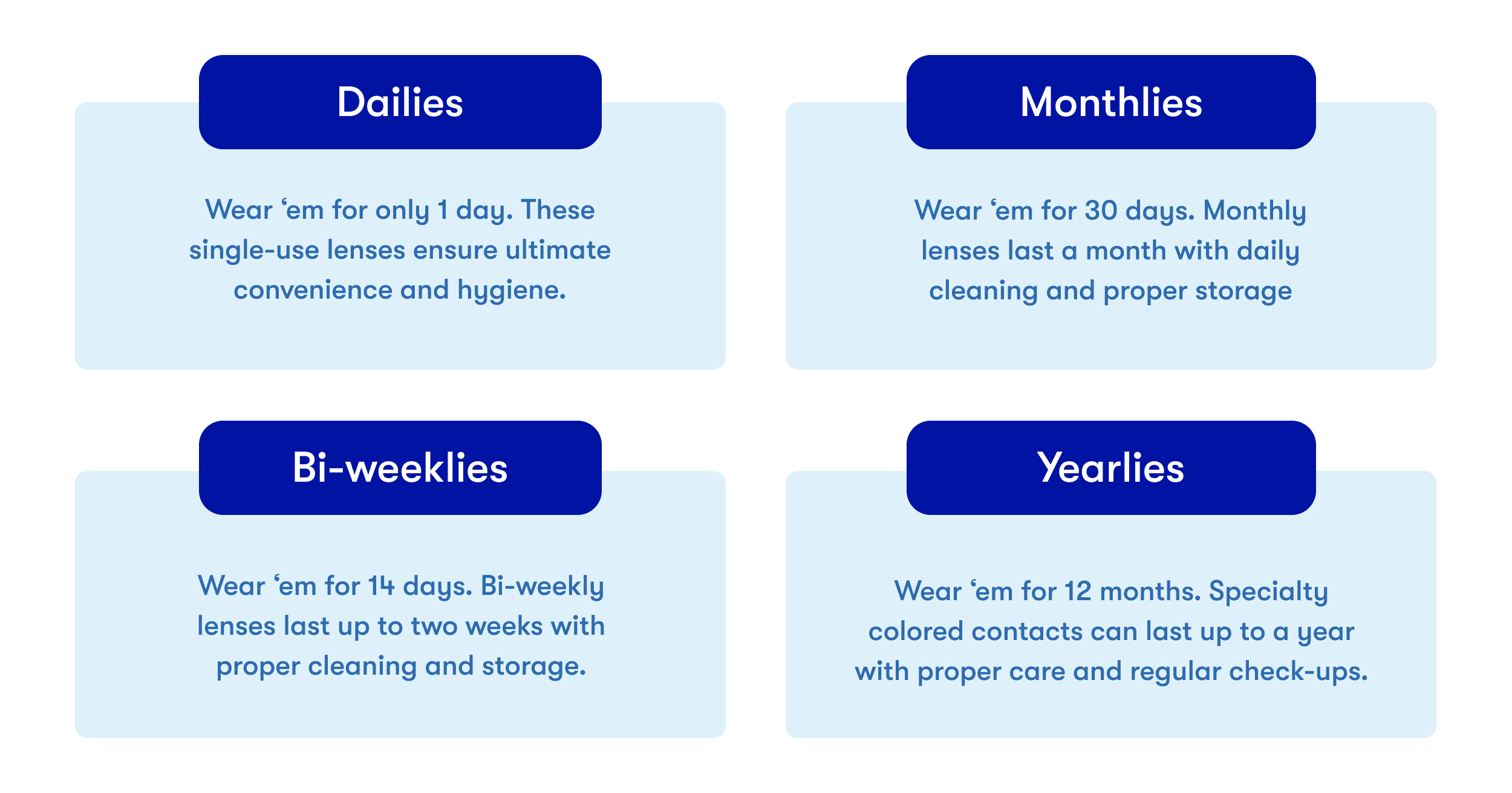
How long can you wear daily contacts?
Daily contacts are also known as single-use contacts because they should be discarded after a single use. This type of contact is not designed to be cleaned or disinfected. They're made thin so they're ultra comfortable to wear, but this makes them too fragile to withstand reuse. Once you're done with a daily lens, you simply take it out and toss it.
How long can you wear biweekly contacts?
Bi-weekly contacts can be worn for up to 14 days. For some people, biweeklies are the just-right, Goldilocks modality. They're usually less expensive than dailies and comfier than monthlies.
How long can you wear monthly contacts?
You can wear your monthly contacts for 30 days. Monthlies are a great option for the cost-conscious, which is probably just about all of us when grocery bills feel like flight prices lately.
How long can you wear yearly contacts?
Yes, yearly contacts exist and can be worn for up to 12 months if you keep up with proper cleaning and storage.
These lenses are best for people with custom or high-power prescriptions because they are made of a thicker material. Yearly contacts might also be a viable solution for someone who is price-conscious, as they typically have the lowest cost-per-wear.
Can you sleep in contacts?
There are a few things in life you should never try to do. Don't take candy from a baby. Don't steal from the homeless. And don't sleep in your contact lenses.
Sleeping in your contacts comes with serious risks:
-
Reduced oxygen and moisture. When you close your eyes to sleep, you stop blinking. Your contact lens then blocks oxygen and moisture from reaching your cornea, which can lead to cell damage.
-
Trapped bacteria. Contacts can trap debris and bacteria against your eye. Because you're not blinking, the bacteria aren't disturbed or moved out of the eye. Instead, the germs are left to thrive and multiply quickly. This creates a potential breeding ground for infections. Imagine that you're giving these germs the perfect party landscape, except your health will have to pay the cleanup bill.
-
Increased risk of infection. Studies show that sleeping in contacts increases your risk of eye infections by 6 to 8 times.
Can you close your eyes for 10 minutes with contacts?
We may need to scream it from the rooftops. No sleeping in contacts. Ever.
Even a 10-minute nap can significantly reduce the amount of oxygen reaching your eyes, immediately increasing your risk of an eye infection.
Can you take a 20-minute nap in contacts?
If you can't take a 10-minute nap, you certainly can't take a 20-minute nap in contacts. See above for the many, many reasons why.
Perhaps you're asking because you found a different answer online. Some AI-generated results online say a 10- or 20-minute nap with contacts is short enough to be safe. But this is exactly why we can't let the robots take over. Eye doctors recommend avoiding sleeping with contacts in, ever.
What is the 4-to-1 rule for contact lenses?
The 4-to-1 rule is a health and safety recommendation that individuals take a 1-hour break from their contact lenses for every four hours of wear. Simply take out the lenses and store them safely in a cleaning solution in a proper container.
This rule helps ensure eyes get a break, reducing eye strain. It also improves oxygen flow, which helps reduce the risk of eye health complications.
What happens if you wear your contacts for too long?
The more specific question is, what happens to your eyeballs if you wear your contacts for longer than recommended? Because eyeballs aren't as disposable as contact lenses.
Wearing contacts too long can come with risks ranging from mild to severe, depending on the timeframe you're dealing with.
Here are the potential consequences you'll be dealing with if you didn't listen to our dire warning:
-
Blurred vision. Throughout the day, your contact lenses collect debris and proteins from your eyes. This dirt buildup, along with other factors such as limited oxygen supply, can lead to blurred vision.
-
Contact lens intolerance. If you have enough complications from your contacts, it can eventually lead to a long-term intolerance to wearing them.
-
Corneal damage. One of the most severe potential consequences is corneal damage. Contact lens overuse and misuse can damage the corneal stem cells and ultimately impact vision.
-
Dryness and irritation. Contact lenses can absorb tears, so the longer you wear them, the drier and more irritated your eyes will feel.
-
Hypoxia. Wearing your contacts for too long can cause hypoxia, a condition in which the cornea doesn't get enough oxygen, leading to abnormal blood vessel growth.
-
Infections and corneal ulcers. Prolonged, consistent overwearing of contact lenses can cause tiny tears in your corneal surface, creating an opening for bacteria to enter and an infection to develop. You can develop a severe infection known as a corneal ulcer, an open sore on the cornea.
-
Sensitivity to light. Dry or irritated eyes, from overwearing contacts, can also make your eyes more sensitive to light.
Hopefully, by now, you've been convinced to follow the general guidelines on how long you should wear your contacts for. The general rule is to avoid wearing them for more than 16 hours a day and to follow the wear guidelines for each contact lens type (bi-weekly, monthly, etc.).
Need to restock on contacts? You can restock with 1-800 Contacts in just three steps. And if you need a new prescription, just start with our online vision exam. Take care of all your contact lens needs right from your computer.
Original publish date: 5/4/22
Updated: 1/23/26